

Galaxies
These entries show entire stellar systems far beyond the Milky Way, from face-on spirals to thin edge-on disks. Their structures reveal dust lanes, bars, spiral arms, companions, and the long effects of gravity over cosmic time.
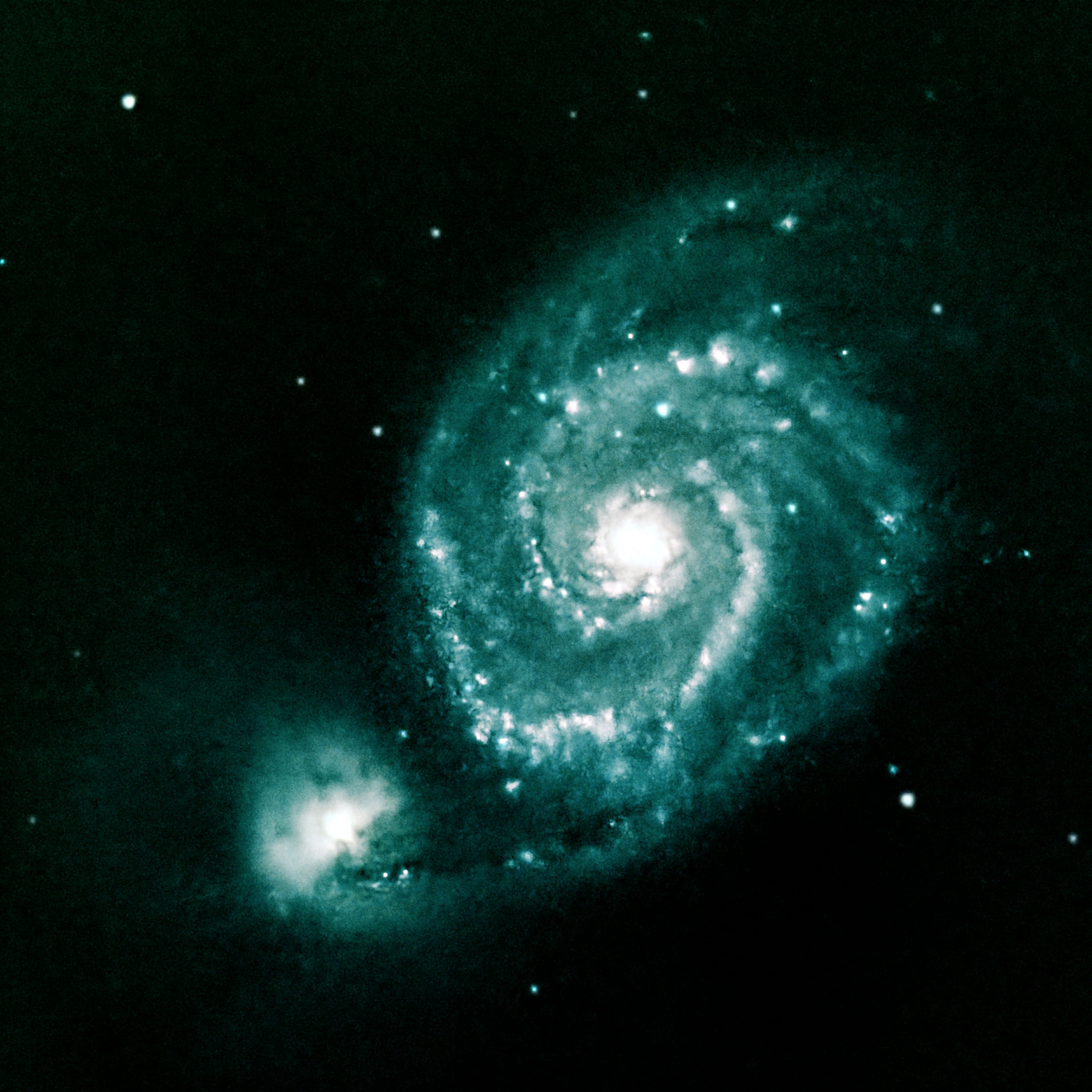
Whirlpool Galaxy (M51)
The Whirlpool is the archetype of a grand-design spiral, the object that taught nineteenth-century astronomers what a galaxy actually is. When Lord Rosse first sketched its arms in 1845, the very idea that the universe contained other rotating systems of stars suddenly had a face to attach to it. Two galaxies are caught here in slow gravitational embrace — the larger one warping under the tug of its smaller companion, the encounter triggering bursts of newborn stars along the arms. It is one of the great astronomical sights, and it deserves every minute of attention it gets.
The Whirlpool Galaxy, catalogued as Messier 51 (M51a, NGC 5194), is a grand-design spiral galaxy in the constellation Canes Venatici, lying at a distance of approximately 23 million light-years. It is interacting gravitationally with the smaller companion galaxy NGC 5195 (M51b), and that tidal interaction is responsible for enhancing the spiral arms and triggering ongoing star formation visible as pink H II regions strung along the arms. M51 spans about 76,000 light-years across, roughly three-quarters the diameter of the Milky Way. Its integrated apparent magnitude is about 8.4, and on the sky it covers roughly 11×7 arcminutes. The galaxy hosts a supermassive black hole at its core with a mass on the order of one million solar masses, and Hubble images revealed a striking dark ‘X’ of dust crossing the nucleus in 1992. Several supernovae have been observed in M51 in recent decades, including SN 2005cs and SN 2011dh. It is best imaged from late winter through early summer in the northern hemisphere.
Personal commentary from George — coming soon. How the image was captured, what he likes about the result, and where he would like to take it next.
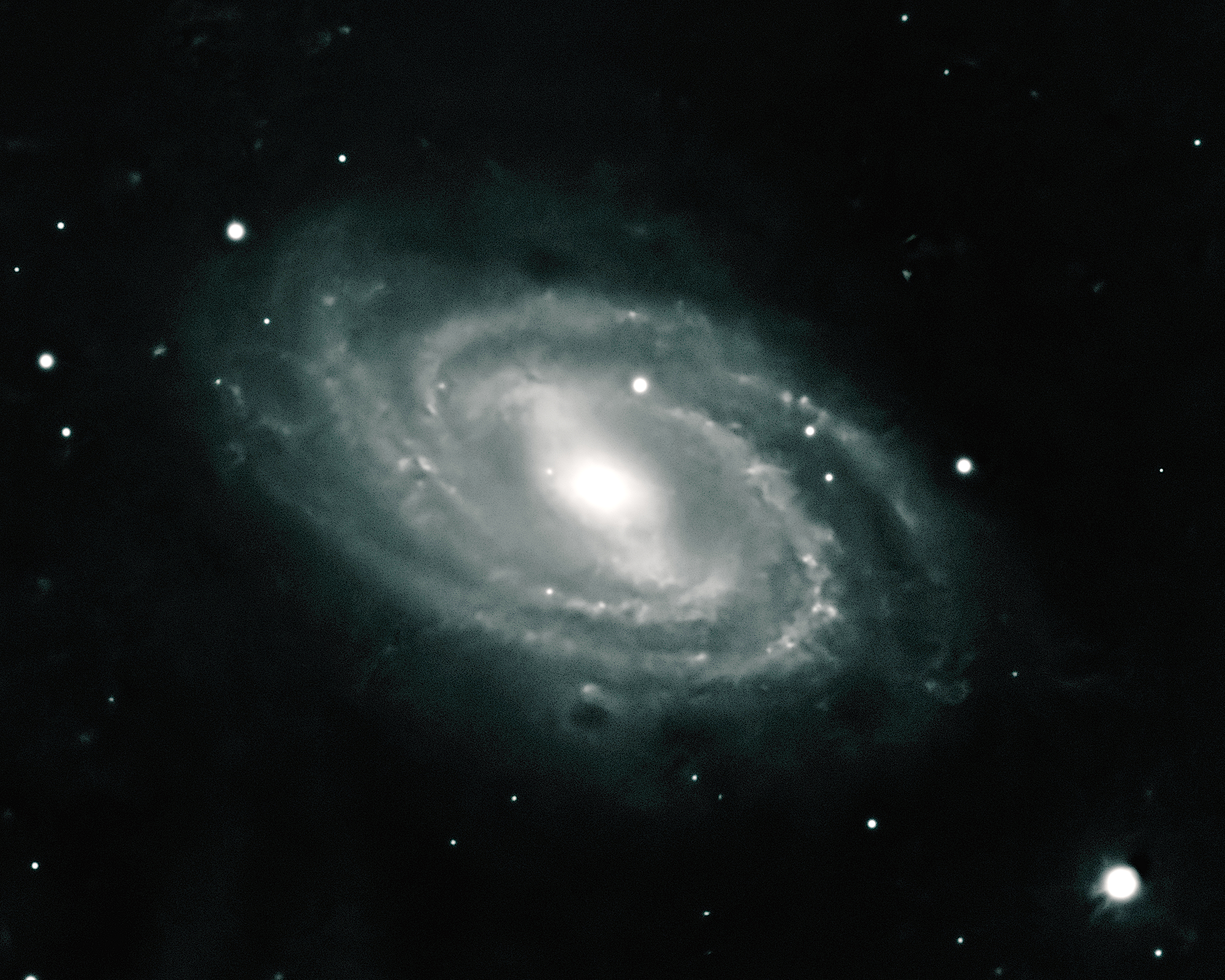
Messier 109 (M109)
M109 is one of the under-celebrated galaxies of the northern sky — a barred spiral seen at a slight tilt, parked just a fraction of a degree from one of the brightest stars in the Big Dipper. To resolve its central bar and trace its soft, well-wound arms is to look across eighty-four million light-years at a system noticeably larger than the Milky Way, presiding over its own modest cluster of companion galaxies. It is the kind of object whose quiet beauty only really emerges once you give it the integration time it deserves.
Messier 109 (NGC 3992) is a barred spiral galaxy in the constellation Ursa Major, located about 0.7° southeast of the star Phecda (γ Ursae Majoris) in the bowl of the Big Dipper. Its distance is approximately 84 million light-years, and it has an apparent magnitude of about 9.8. It spans roughly 7.6×4.7 arcminutes on the sky, corresponding to a physical diameter near 180,000 light-years — considerably larger than the Milky Way. M109 is the brightest member of the M109 Group, a small galaxy group that includes the fainter companions UGC 6923, UGC 6940, and UGC 6969. The galaxy is classified as type SBbc, indicating a well-developed central bar and moderately-wound spiral arms. Supernova SN 1956A, a Type Ia, was observed in M109 in 1956. The galaxy has the distinction of being the most distant Messier object — the deepest single entry in Charles Messier’s eighteenth-century catalogue. It is best imaged from spring through early summer in the northern hemisphere.
Personal commentary from George — coming soon. How the image was captured, what he likes about the result, and where he would like to take it next.
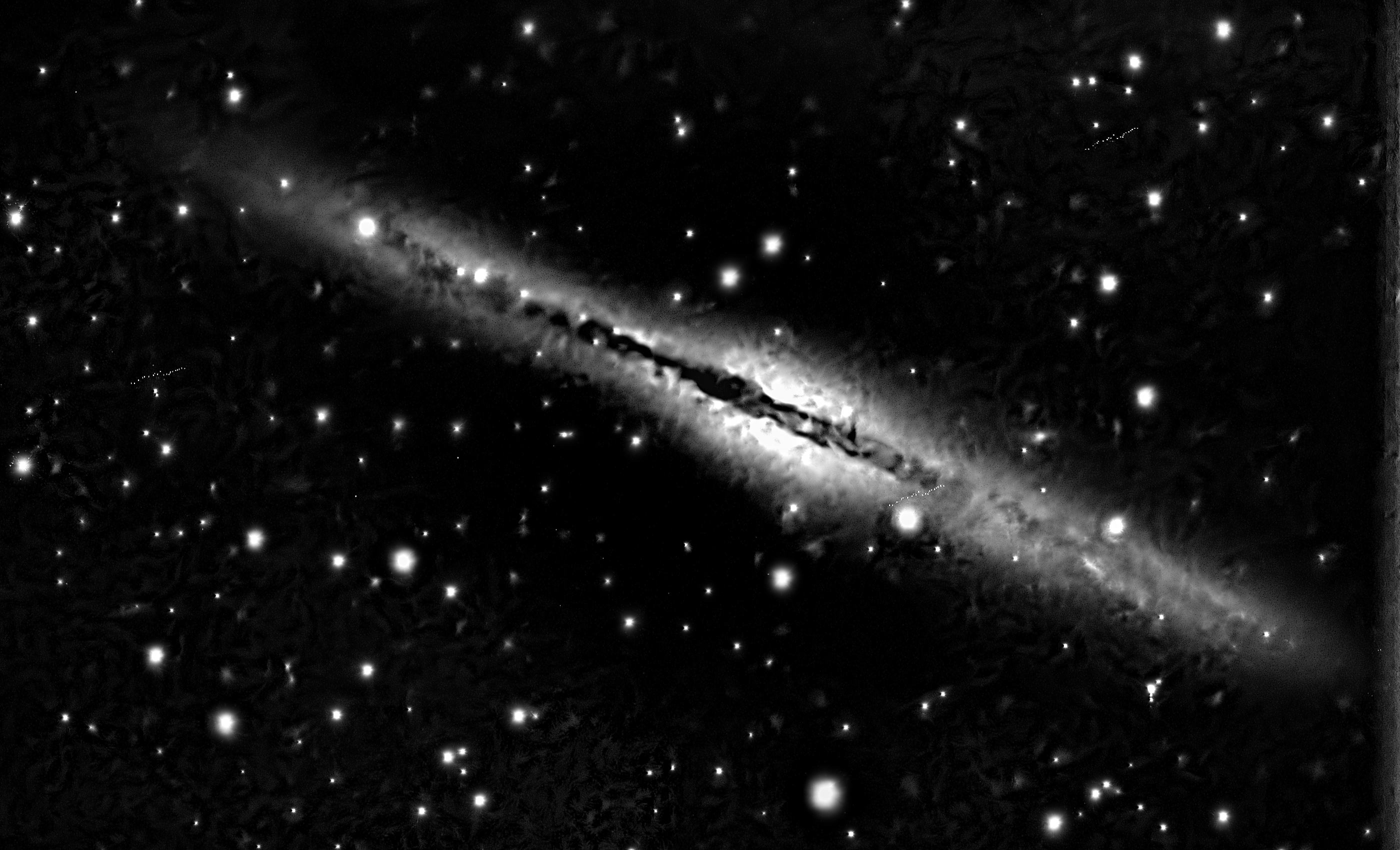
NGC 891
NGC 891 shows what a galaxy looks like edge-on, and the view is unforgettable. A long, thin disc of starlight is cut clean through its centre by a thick dark lane of dust, every grain of which is the cooled exhaust of an earlier generation of stars. Looking at it is the closest we get to seeing the Milky Way itself from outside, because the two galaxies are near twins. Few astronomical sights make the architecture of our own home so suddenly and physically real.
NGC 891 is an edge-on, unbarred spiral galaxy in the constellation Andromeda, located approximately 30 million light-years away. It has an apparent magnitude of about 10.0 and an angular size of roughly 13.5×2.5 arcminutes, corresponding to a physical diameter near 120,000 light-years. Its near-perfect edge-on orientation — inclination essentially 90° — produces the striking central dust lane that bisects the visible disc and is one of the most photographed dark structures in extragalactic imaging. Deep exposures reveal numerous extraplanar dust filaments rising perpendicular to the plane of the disc — chimneys of material lifted out of the disc by supernova-driven outflows — and a faint stellar halo extending to large radii. NGC 891 is morphologically very similar to the Milky Way and is regularly used as a structural analogue in studies of disc galaxy anatomy. It is the brightest member of the NGC 1023 Group. The galaxy is well placed for northern-hemisphere imaging from autumn through early winter.
NGC 891 is one of the visitors my Hidden Springs balcony actually lets me catch — it sits in my available patch of sky for long enough to gather a little light. I framed it through the Celestron 14 EdgeHD with the ASI533MM Pro on luminance only, perhaps ten frames in all on a single night. It was one of the images I was working with while learning PixInsight. The dust lanes are suggested rather than properly resolved; I’d love to revisit and pour real integration time into them. What I enjoy is the geometry — galaxies presented at different angles never get old, and NGC 891 sits practically edge-on, a slim quiet profile.
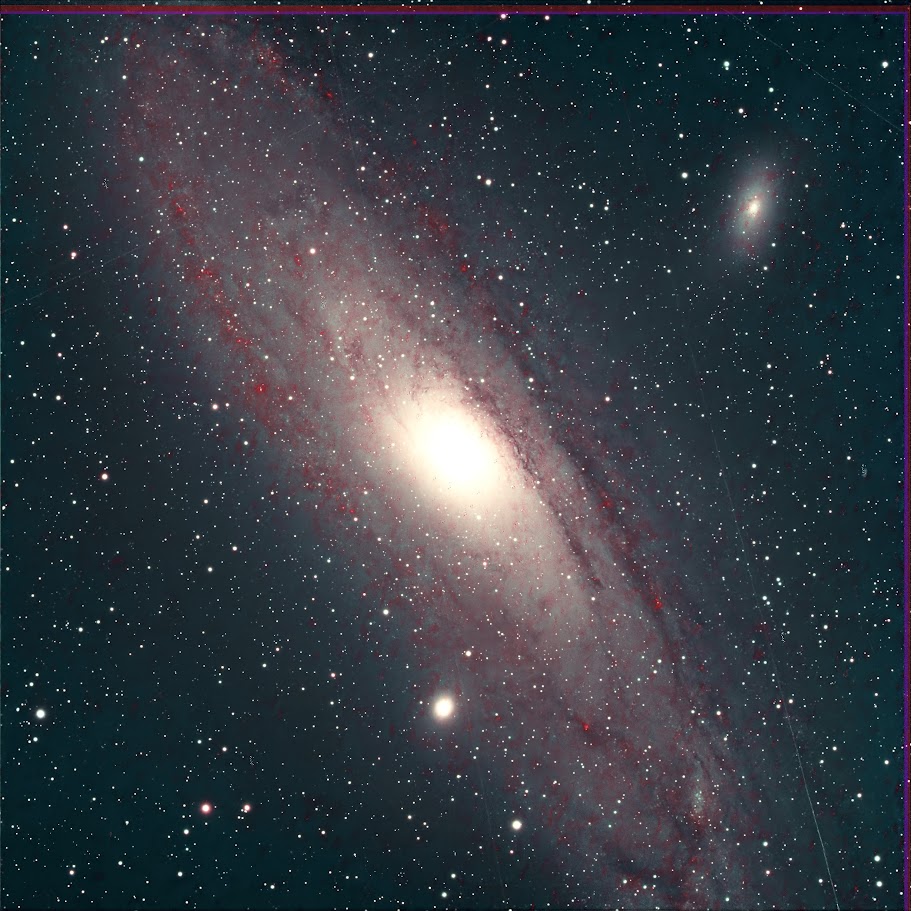
Andromeda Galaxy (M31)
Andromeda is staggering even before you point any instrument at it. It is the most distant object the unaided human eye can resolve — a trillion-star spiral, two and a half million light-years away, drifting across the autumn sky as a soft elongated glow. Its light reaching us tonight set out before our species existed. And it is heading toward us, falling along an unstoppable orbit that will, in roughly four billion years, merge it with the Milky Way into a single new galaxy. To see it is to look directly at the future of our own.
The Andromeda Galaxy, Messier 31 (NGC 224), is a large barred spiral galaxy in the constellation Andromeda, lying at a distance of approximately 2.5 million light-years — the nearest large spiral to the Milky Way. It has an apparent magnitude of about 3.4 and an angular size of roughly 3°×1°, making it the largest galaxy in the sky as seen from Earth, spanning more than six full Moons in length. Its physical diameter is approximately 152,000 light-years and it contains an estimated one trillion stars, more than twice the stellar population of the Milky Way. The galactic nucleus shows a curious double-cluster (P1–P2) structure attributed to an eccentric stellar disc around a supermassive black hole of roughly 100 million solar masses. M31 is the dominant member of the Local Group and has at least 14 known satellite galaxies, including M32 and M110, both visible in moderate exposures. It is approaching the Milky Way at about 110 kilometres per second; the two are expected to begin merging in roughly 4 to 4.5 billion years. M31 is best imaged from late summer through winter in the northern hemisphere.
Personal commentary from George — coming soon. How the image was captured, what he likes about the result, and where he would like to take it next.
NGC 7331
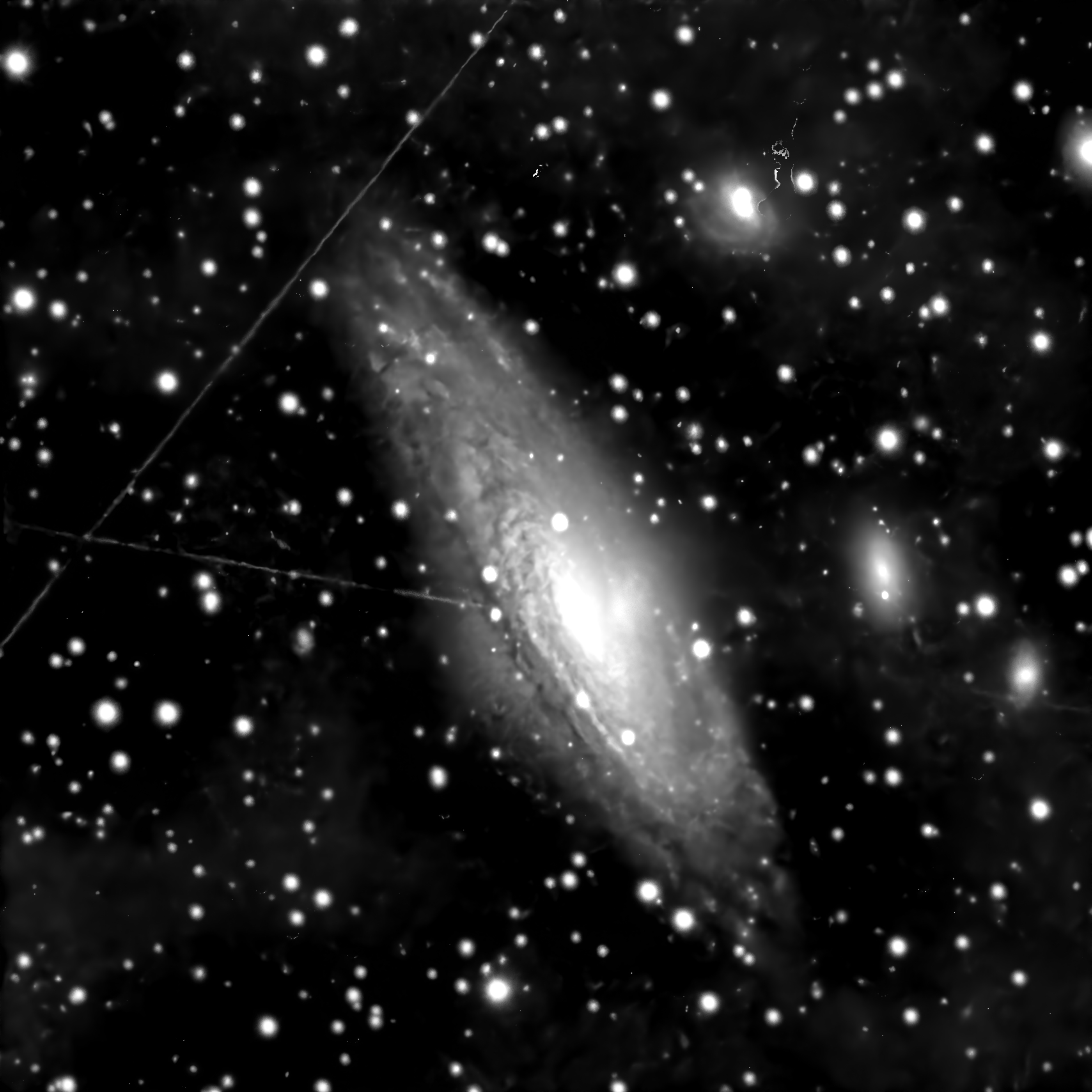
NGC 7331 is sometimes called the Milky Way’s twin, and for once the comparison is fair. It is a large unbarred spiral seen at a comfortable tilt, with a luminous central bulge and arms wound in a familiar, almost domestic geometry. Behind it, in the same field of view, sits a scatter of much smaller, much more distant galaxies — a depth-of-field effect that quietly reminds the viewer that the cosmos is layered, not flat, and that every frame of deep sky contains worlds at wildly different distances.
NGC 7331 is an unbarred spiral galaxy in the constellation Pegasus, located approximately 40 million light-years away. It has an apparent magnitude of about 9.5 and an angular size of roughly 10.5×3.7 arcminutes, corresponding to a physical diameter near 120,000 light-years — very similar to the Milky Way, which it is often cited as resembling structurally. Its inclination of about 75° produces a strongly tilted view of its spiral arms and central bulge. Unusually, the bulge rotates in the opposite sense from the surrounding disc, suggesting a complex merger history. NGC 7331 is the brightest member of the NGC 7331 Group (informally the Deer Lick Group), which includes the much more distant background galaxies NGC 7335, NGC 7336, NGC 7337, and NGC 7340. Those four lie roughly ten times farther away and often appear in the same frame, providing a striking depth-of-field effect. The famous Stephan’s Quintet lies only about half a degree away on the sky. The galaxy is well placed for northern-hemisphere imaging from late summer through autumn.
Personal commentary from George — coming soon. How the image was captured, what he likes about the result, and where he would like to take it next.
Pinwheel Galaxy (M101)
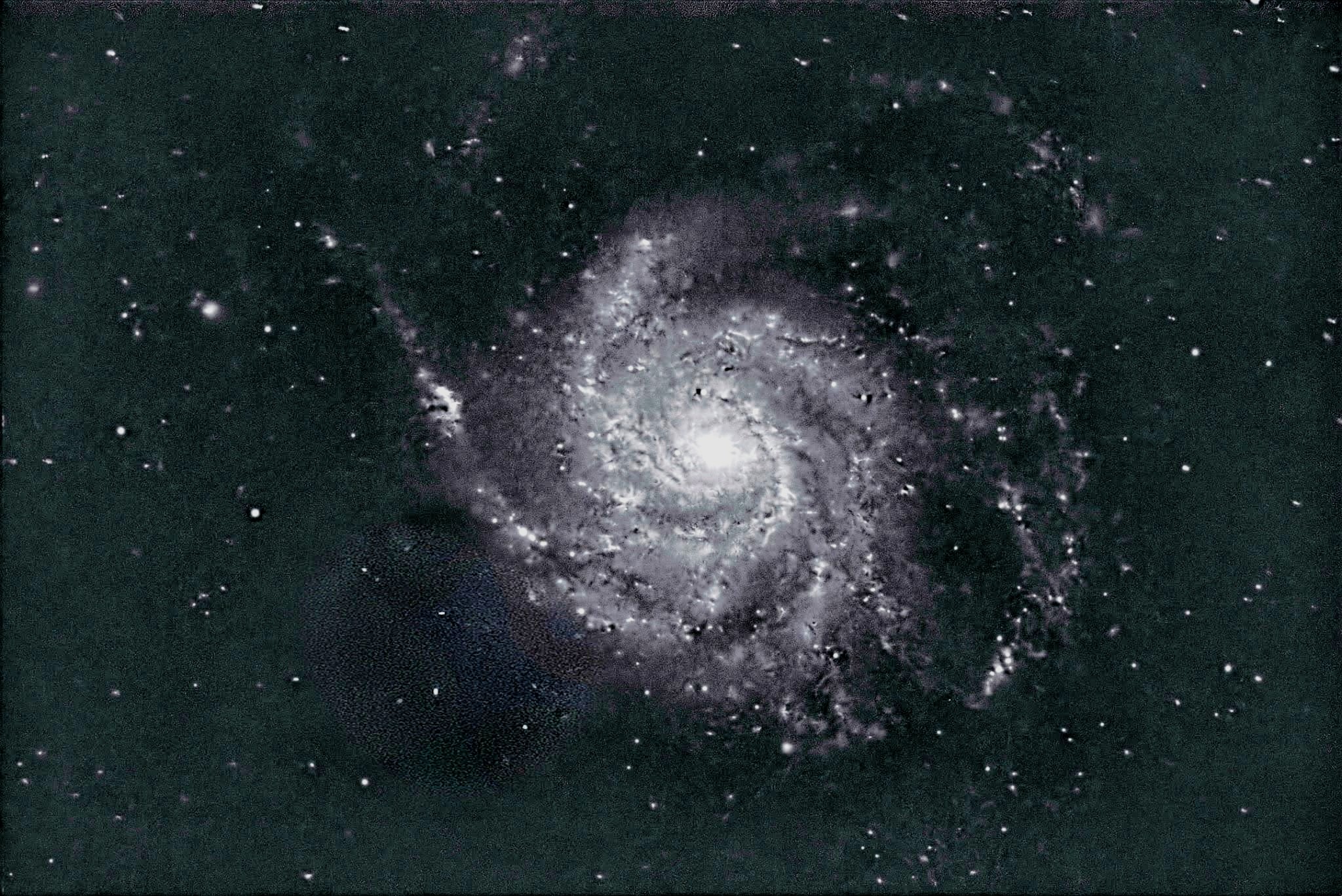
The Pinwheel is one of the largest disc galaxies in our cosmic neighbourhood, presented face-on so its arms can be counted and traced. It is almost twice the diameter of the Milky Way, spanning a region of sky nearly the size of the full Moon, and it is gently distorted — a lopsidedness born of long gravitational pulls from smaller companions. Knots of pink hydrogen mark the places where new stars are currently being made by the thousand. M101 is what a healthy spiral galaxy looks like at its best.
The Pinwheel Galaxy, Messier 101 (NGC 5457), is a face-on unbarred spiral galaxy in the constellation Ursa Major, at a distance of approximately 21 million light-years. It has an apparent magnitude of about 7.9 and an angular size of roughly 28.8×26.9 arcminutes, almost the size of the full Moon. Its physical diameter is about 170,000 light-years — nearly twice the size of the Milky Way — making it one of the largest disc galaxies in our cosmic neighbourhood. The disc is noticeably asymmetric, distorted by gravitational interaction with several smaller companion galaxies including NGC 5474. M101 contains several thousand identified H II regions, an unusually rich population; many of the brightest are individually catalogued (NGC 5447, NGC 5462, NGC 5471 and others). Supernova SN 2011fe — one of the closest and best-studied Type Ia supernovae of the past century, caught within hours of explosion and crucial for refining cosmological distance measurements — was observed in M101 in August 2011. It is best imaged from late winter through early summer in the northern hemisphere.
One of only two clear nights I’d had all winter, and a chance to try my new ASI2600MM Pro on something completely iconic — M101, face-on, those spiral arms hardly need further justification. Through the Celestron 14 EdgeHD from my Hidden Springs balcony, I shot rudimentary LRGB plus a little H-alpha to sharpen — maybe sixteen subframes total at thirty seconds each, three or four per filter. A first experiment in combining channels from filtered subs. I’m surprised how well it holds together at small scale: the general character of the galaxy comes through. It doesn’t bear pixel-peeping. Ten hours of light from this rig would do M101 real justice.
Tiger’s Eye Galaxy
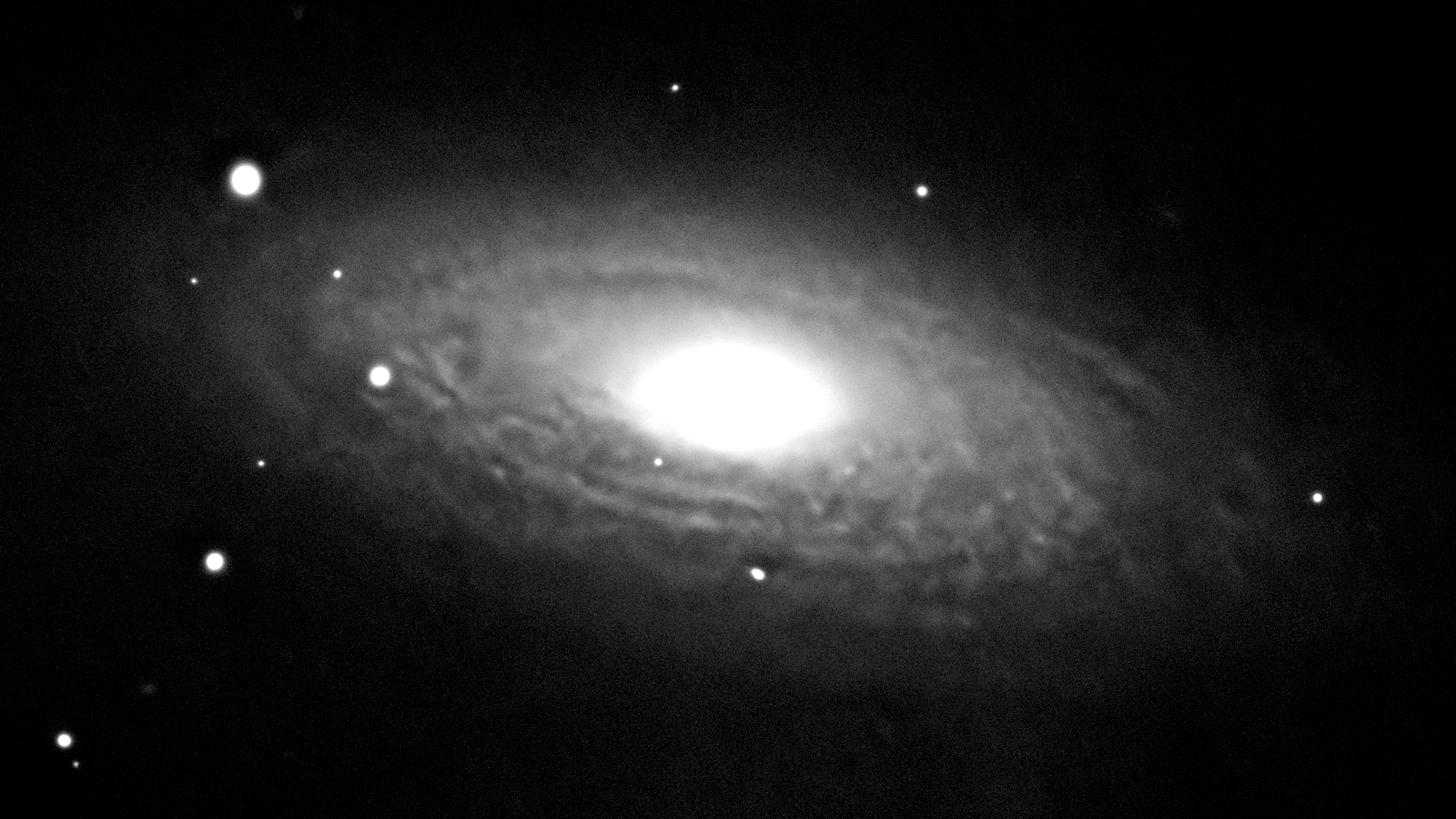
The Tiger’s Eye Galaxy is a quiet, austere spiral tilted just enough to show off the layered architecture of its disc. Tightly wound flocculent arms wrap around a brilliant central bulge, and faint dust lanes thread through like fine sediment in clear water. There is no dramatic interaction here, no recent burst of new stars — just the slow, patient rotation of an old galaxy doing what spirals do best. Its restraint is precisely what makes it beautiful.
NGC 2841, popularly known as the Tiger’s Eye Galaxy, is an unbarred spiral galaxy in the constellation Ursa Major, located approximately 46 million light-years away. It has an apparent magnitude of about 9.2 and an angular size of roughly 8.1×3.5 arcminutes, corresponding to a physical diameter near 150,000 light-years — moderately larger than the Milky Way. The galaxy is classified as type SAa or SAb and is the prototype example of a ‘flocculent’ spiral: instead of two well-defined grand-design arms, it shows numerous short, patchy spiral segments threaded with delicate dust lanes. Its inclination of about 65° highlights both the luminous central bulge and the layered disc structure. NGC 2841 is unusual among large spirals in having a very low rate of ongoing star formation; ultraviolet observations show only modest H II activity, marking it as a relatively quiescent disc. The galaxy lies in the loose Leo Spur group of nearby galaxies. It is best imaged from late winter through spring in the northern hemisphere, when Ursa Major is high overhead.
Personal commentary from George — coming soon. How the image was captured, what he likes about the result, and where he would like to take it next.
Triangulum Galaxy (M33)
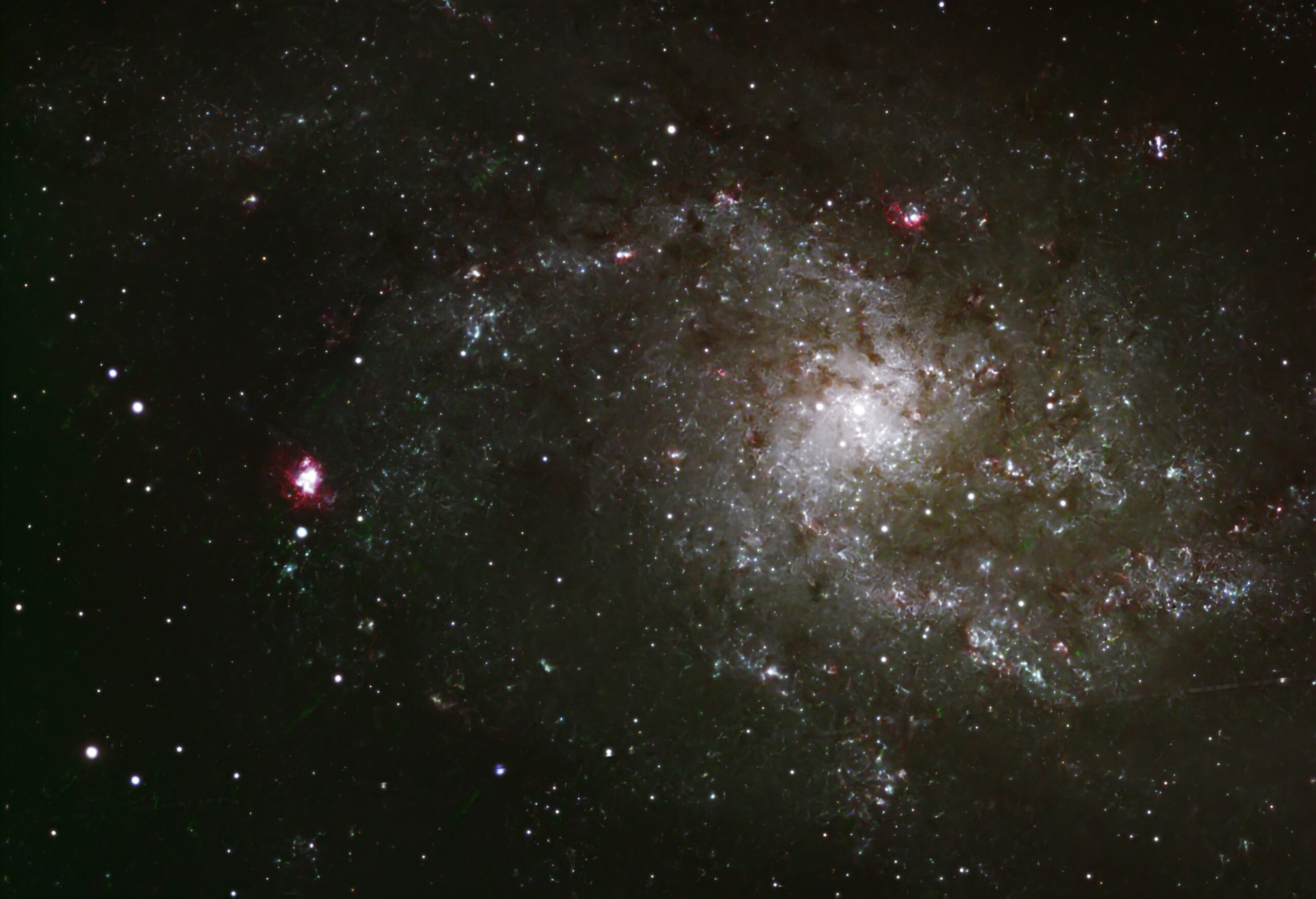
M33 is the third-largest member of our Local Group, after Andromeda and the Milky Way, and it presents itself face-on so its architecture is completely legible. The arms are loose and lumpy rather than tightly wound, punctuated by dozens of pink hydrogen clouds where young stars are being born. The brightest of these, NGC 604 on the left side of the frame, is one of the largest star-forming regions known anywhere — forty times the diameter of the Orion Nebula. At about 2.7 million light-years, M33 is among our closest galactic neighbours.
The Triangulum Galaxy, Messier 33 (NGC 598), is a face-on unbarred spiral in the constellation Triangulum, at a distance of approximately 2.73 million light-years. It has an apparent magnitude of about 5.7 and an angular size of roughly 70×42 arcminutes — more than twice the width of the full Moon — corresponding to a physical diameter near 60,000 light-years. It is classified as type SA(s)cd, meaning an unbarred spiral with loosely wound arms and no prominent central bulge. M33 is the third largest member of the Local Group after the Andromeda Galaxy and the Milky Way, and is gravitationally bound to M31; the two galaxies may share a common tidal envelope of neutral hydrogen. Its most prominent H II region, NGC 604, visible as a bright pink knot on the eastern side of the disc, is one of the largest known star-forming regions in the Local Group — about 1,500 light-years across and forty times the diameter of the Orion Nebula. M33 has an unusually low surface brightness for its total magnitude, which makes it notoriously demanding to image well: it requires dark skies, a wide field, and long total integration. It is best imaged from late summer through early winter in the northern hemisphere.
Taken from the balcony with the C14 EdgeHD at f/7 — the 0.7× reducer in place — and pulled together from LRGB only, no narrowband. Around fifty or sixty subs went into the stack. I’ve nudged up the two largest H II regions in the arms to bring out their pink, but the colour balance otherwise aims for something close to the true palette. Focus was better than usual on this one, which I noticed at once, though there’s always room to do better. I’d like to attempt a spectrographically balanced version one day. The frame isn’t quite symmetric — a small crop would help — but as a first pass on M33 I’m pleased.