

Planetary Nebulae
These objects are the glowing shells of gas expelled by dying Sun-like stars. Their compact forms often show rings, bubbles, and layered internal structure.
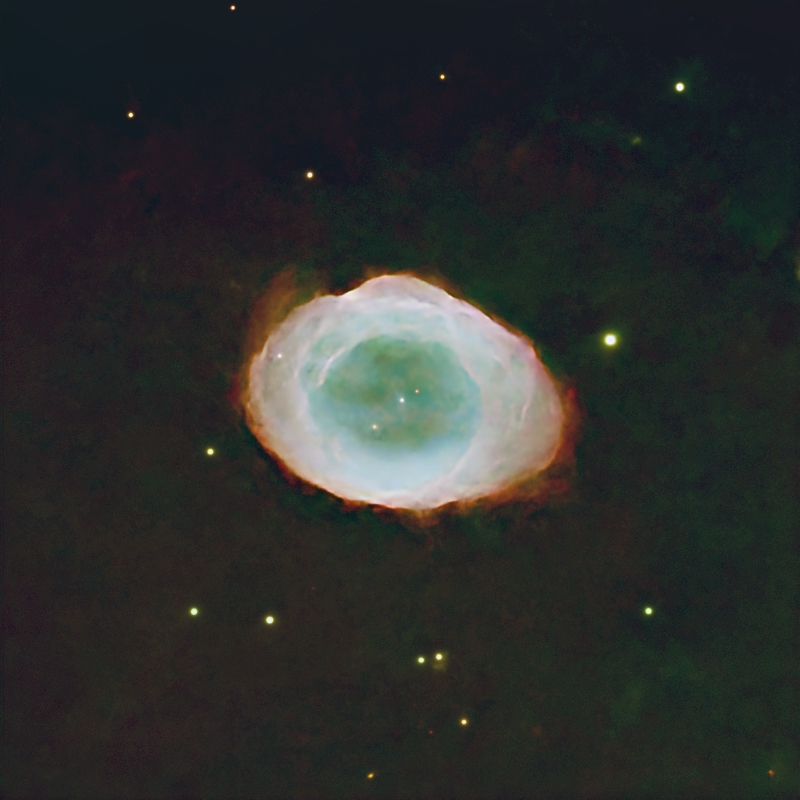
Ring Nebula (M57)
The Ring Nebula is the most readable picture in the sky of what awaits a sun-like star. A perfect luminous loop set against the rich star fields of Lyra, M57 is the expanding outer atmosphere of a star that died only a few thousand years ago. At the centre, faintly visible in deep exposures, sits its bare hot core — a white dwarf now cooling on a timescale of billions of years. Few objects compress so much stellar biography into so small and elegant a shape.
The Ring Nebula, Messier 57 (NGC 6720), is a planetary nebula in the constellation Lyra, located approximately 2,300 light-years from Earth. It has an apparent magnitude of about 8.8 and an angular size of roughly 1.4×1.0 arcminutes, corresponding to a physical extent of about one light-year along its long axis. The nebula is the expanding outer envelope of a low-to-intermediate mass star that has shed its outer layers near the end of its life; the remaining hot core is now a white dwarf with an apparent magnitude of about 15.7 visible at the centre of the ring. The visible expansion began roughly 6,000 to 8,000 years ago and continues at about 20 to 30 kilometres per second. The familiar bright loop is in fact the rim of a much more complex three-dimensional structure: deep imaging shows the nebula is actually a barrel-shaped shell with elaborate outer halos and dark molecular knots seen in silhouette against the bright gas. It is well placed for imaging through summer in the northern hemisphere.
I remember as a young man in my twenties peering at the Ring through big telescopes, knowing the central star was effectively beyond amateur reach. So I was keen to deliver it as a photograph from my own setup. From the Hidden Springs balcony, through the Celestron 14 EdgeHD with the ASI533MM Pro, I took LRGB subs of about three seconds each, fifty per filter — quite short exposures, but M57 is a bright thing. There it is: the central star clearly visible, with several other stars threading the nebula too. There’s more I’d like to do with M57. For example, I’d like to chase the outer halo properly and resolve its fine structure.
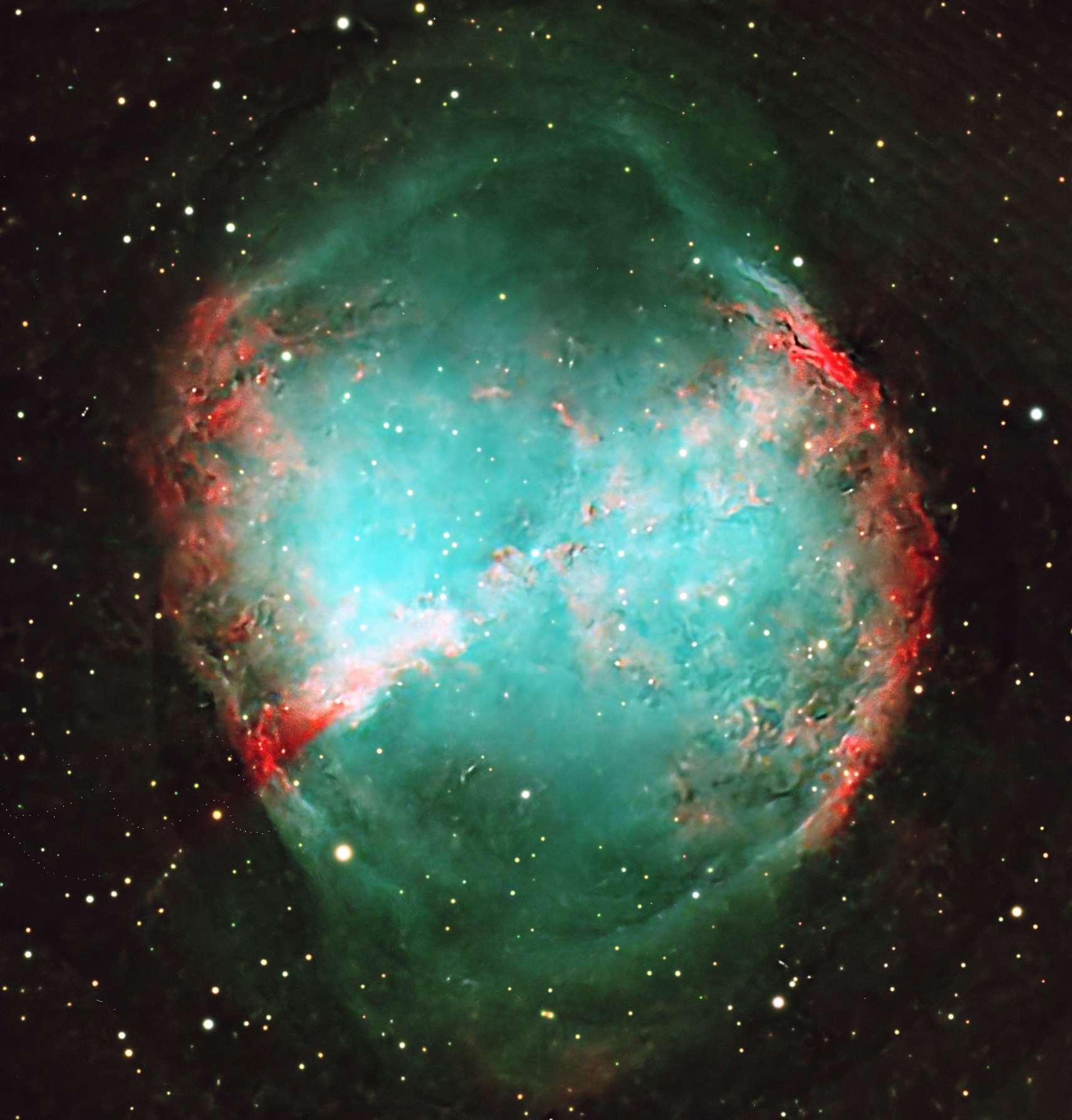
Dumbbell Nebula (M27)
The Dumbbell was the first planetary nebula ever discovered, spotted by Charles Messier in 1764, and it remains one of the most spectacular. Its twin glowing lobes are the dying breath of a star like the Sun, exhaled into space at twenty kilometres a second and lit from inside by the searing ultraviolet of the bare stellar core. The geometry is almost too neat to be accidental — a piece of cosmic calligraphy traced in ionised gas — and the whole structure will fade back into the interstellar medium in only a few tens of thousands of years.
The Dumbbell Nebula, Messier 27 (NGC 6853), is a bright planetary nebula in the constellation Vulpecula, located approximately 1,360 light-years away. It has an apparent magnitude of about 7.5 and an angular size of roughly 8×5.6 arcminutes, making it one of the largest and brightest planetary nebulae visible from Earth, and its physical diameter is approximately 3 light-years. The characteristic bilobed or ‘apple-core’ shape arises from the bipolar geometry of the outflow from the central star, viewed close to the plane of symmetry. M27 is estimated to be roughly 9,800 to 14,600 years old, with an expansion velocity of about 31 kilometres per second. The central star is a hot white dwarf with a surface temperature near 85,000 K — several times hotter than the Sun’s surface — and an apparent magnitude of about 13.5. Deep narrowband [O III] and Hα imaging reveals an extensive outer halo and intricate filamentary structure outside the bright inner lobes. The nebula is well placed for northern-hemisphere imaging from summer into autumn.
Personal commentary from George — coming soon. How the image was captured, what he likes about the result, and where he would like to take it next.
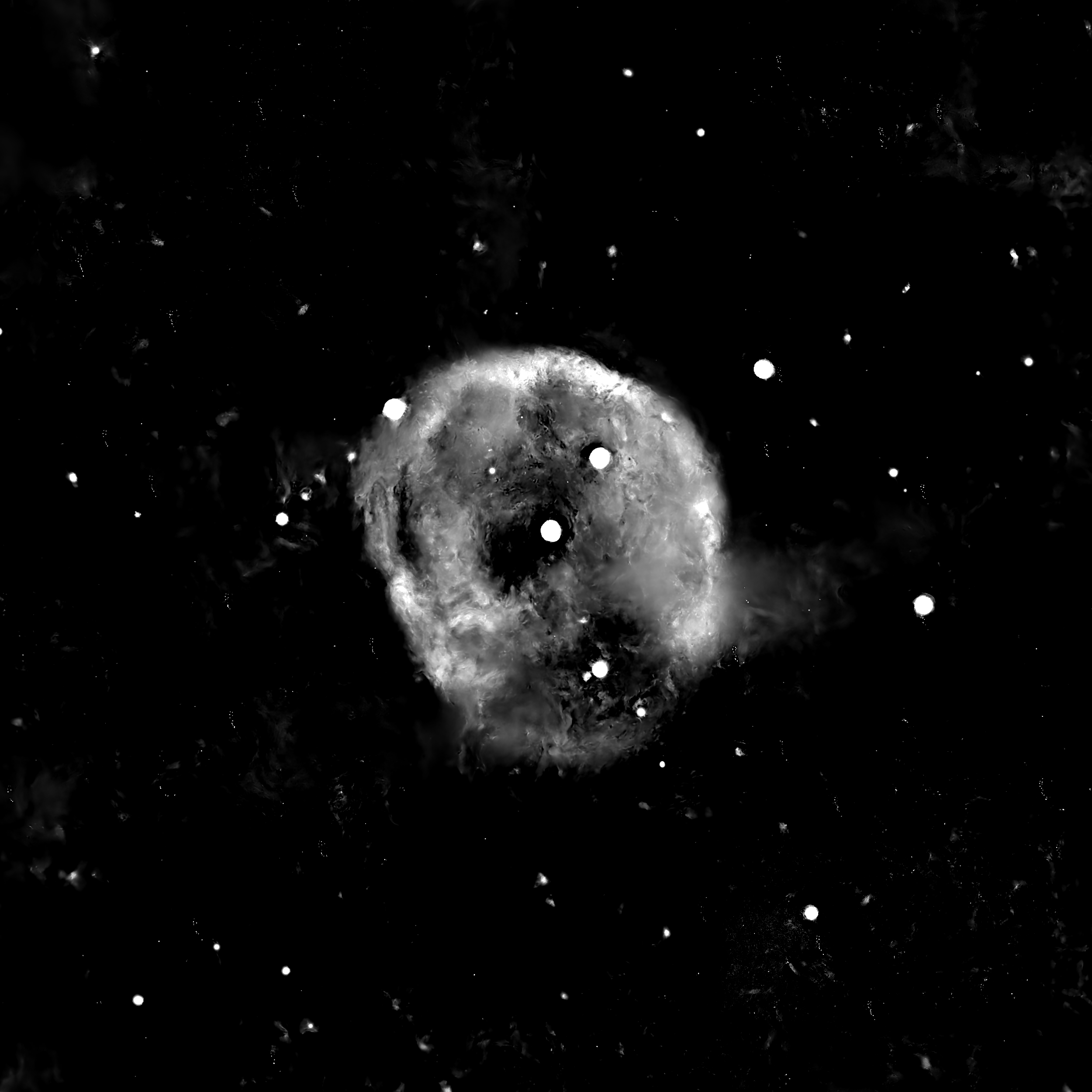
Skull Nebula
The Skull Nebula is one of the more uncanny sights in the deep sky — a faintly luminous, lopsided face peering from a thin patch of Cetus, with two dark hollows where the eye sockets would be. It is dim and rewards real patience to bring out, but once it appears in the data the resemblance is impossible to unsee. Beneath the costume is real physics: a dying star surrounded by the asymmetric remains of its own outer envelope, lit from inside by a punishingly hot white dwarf.
The Skull Nebula (NGC 246, sometimes catalogued as Caldwell 56) is a planetary nebula in the constellation Cetus, located approximately 1,600 light-years away. It has an apparent magnitude of about 8.0 and an angular size of roughly 4 arcminutes, corresponding to a physical diameter near 1.9 light-years. The nebula is the ejected envelope of a low-mass star that has evolved past the asymptotic giant branch; the remnant hot core is a white dwarf of apparent magnitude 11.8. In 2014 the central source was shown to be a hierarchical triple system — a white dwarf with a main-sequence companion plus an outer third component — the first known planetary-nebula nucleus of this kind, and a result that helped explain the nebula’s asymmetric morphology. The dark ‘eye sockets’ are produced by an inhomogeneous distribution of ionised gas around the central source. Narrowband [O III] imaging shows particularly strong inner-shell structure. The nebula is best imaged from northern mid-latitudes in autumn, when Cetus rides high after midnight.
A balmy September evening on my Hidden Springs balcony, and the Skull obligingly sat in the narrow strip of sky my balcony actually shows me — that’s how it got chosen, more than any particular romance. Through the Celestron 14 EdgeHD with the ASI533MM Pro, I gathered five or six dozen luminance subs at exposures from thirty to one-twenty, effectively unguided, conditions drifting between frames. More a pile than a proper stack, but I was learning how to align varied material. I’m pleased with the detail I caught around the rim, and it does end up looking like a skull. Next time I’ll do it justice — and in colour.