

Globular Clusters
These are ancient, gravitationally bound swarms of stars packed into dense spherical systems around the Milky Way. Their visual appeal comes from the transition between brilliant central concentration and resolved outer members.
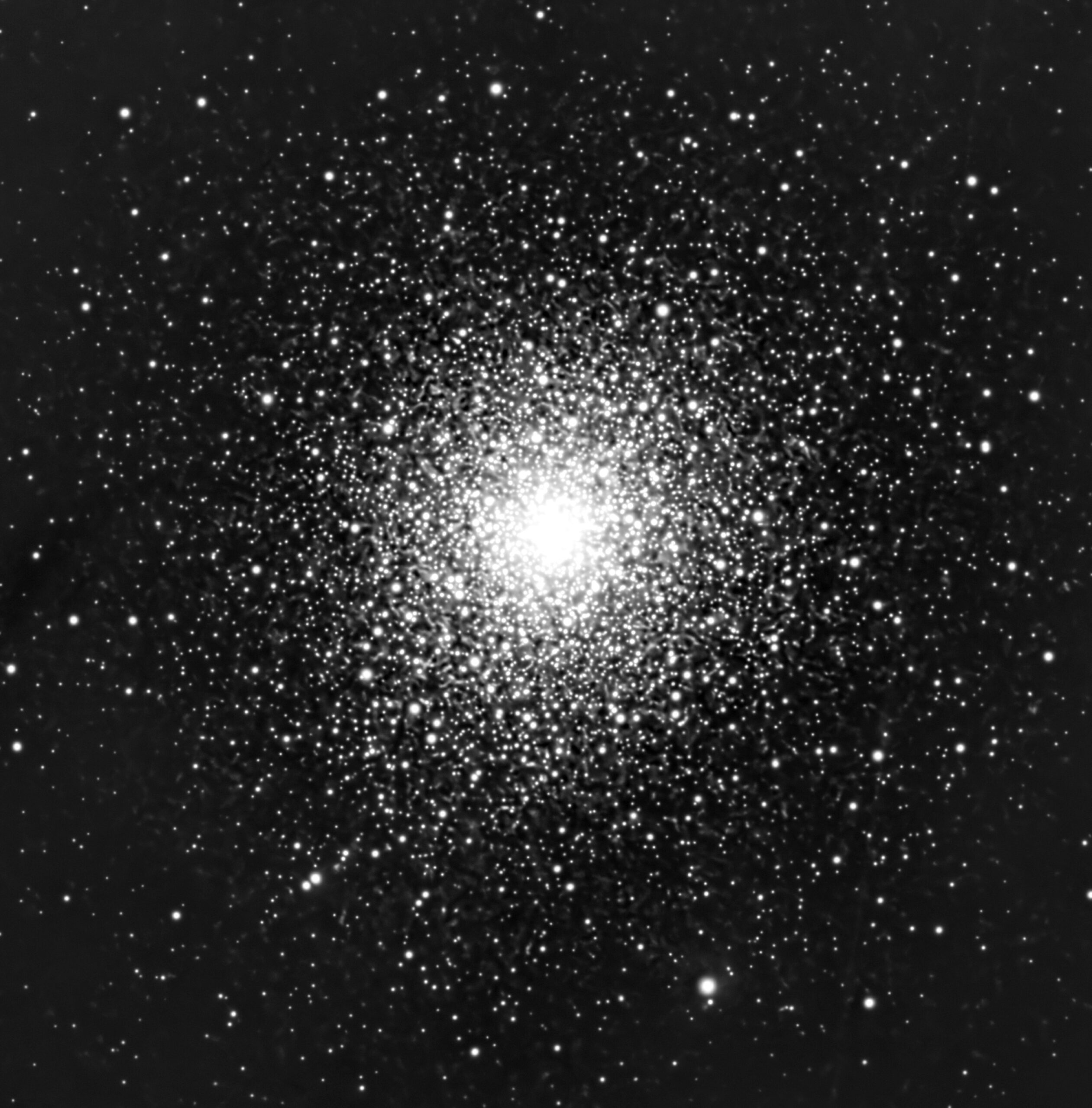
Messier 92 (M92)
M92 is one of the oldest objects the night sky has to offer. A tightly packed sphere of several hundred thousand ancient stars, it formed when the Milky Way was barely a galaxy at all — within a billion years of the Big Bang itself. Its stars are so impoverished in heavy elements that they pre-date almost all the chemistry of the modern universe. To look at M92 in a telescope is to look directly at deep cosmic time, a small piece of the early universe still bound, still orbiting, still shining.
Messier 92 (NGC 6341) is a globular cluster in the constellation Hercules, located approximately 26,700 light-years from Earth and about 33,000 light-years from the Galactic centre. It has an integrated apparent magnitude of about 6.3 — just at the edge of unaided-eye visibility under exceptionally dark skies — and an angular diameter of roughly 14 arcminutes. Its physical diameter is around 109 light-years and its tidal radius extends to nearly 220 light-years. M92 contains an estimated 250,000 to 330,000 stars and has an age of approximately 13.0 billion years, making it one of the oldest known globular clusters in the Milky Way and very close in age to the universe itself (13.8 billion years). Its metallicity is extremely low at [Fe/H] ≈ –2.3, consistent with formation during the earliest epochs of galactic assembly. M92 also passes very close to the Northern Celestial Pole on a 26,000-year precessional cycle and is occasionally cited as a future ‘pole cluster’. It is best imaged from northern spring through autumn.
Globular clusters can be deceptively tricky. So often, when I pixel-peep someone’s M13 or M92, the core dissolves into a kind of saturated white blob that hints at stars without quite resolving them. With this M92, I rather stumbled into the opposite. The session itself was casual, almost a snapshot, and conditions are a bit of a blur in my memory. What rescued it was a play in PixInsight with BlurXTerminator’s star-reduction slider, which I nudged gently rather than aggressively. The effect on the core was unexpectedly elegant: stars become discreet points, the centre still reads as a dense swarm, and the cluster’s structure stays intact rather than melting.
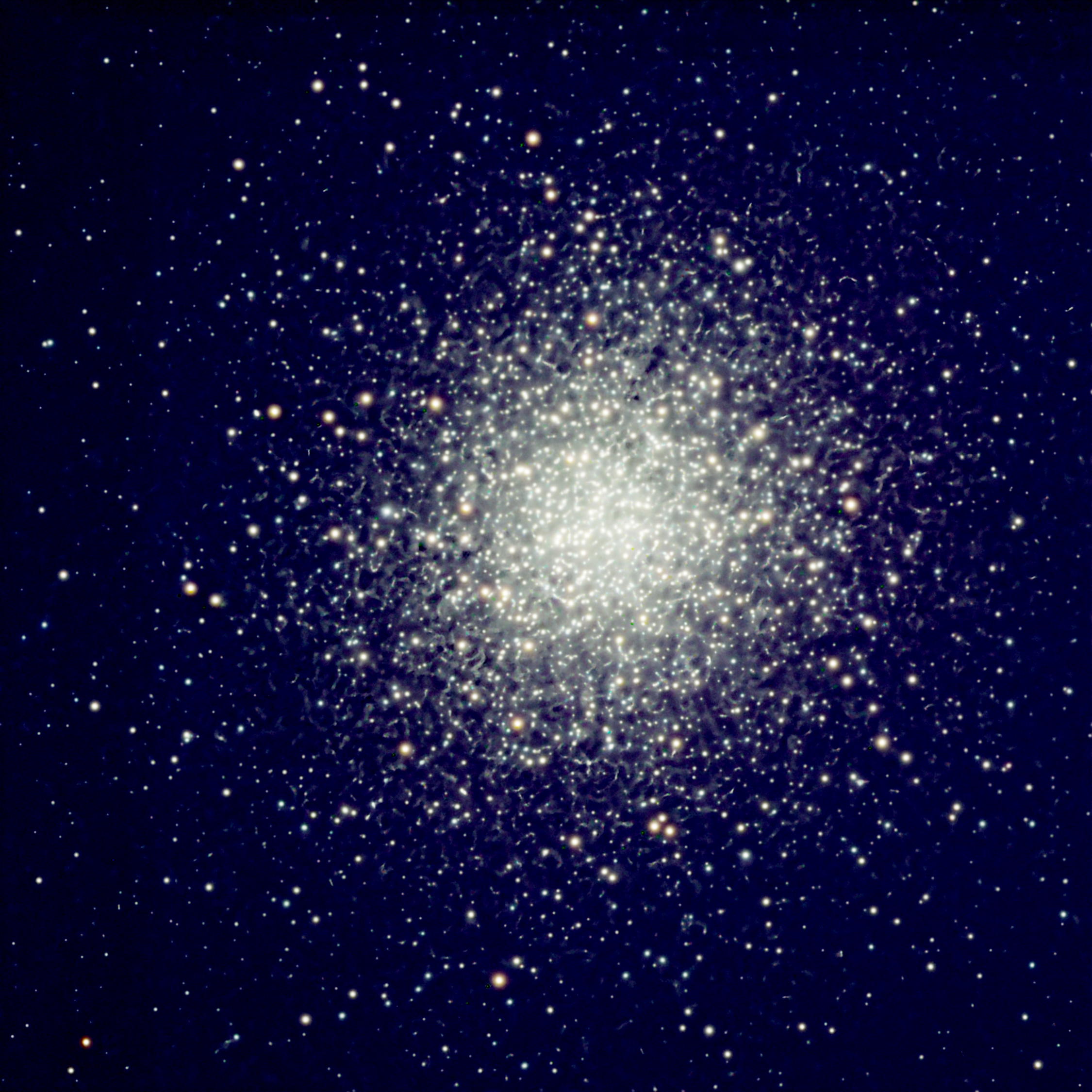
Messier 13 (Great Hercules Cluster)
M13 is the showpiece globular cluster of the northern sky — several hundred thousand ancient stars locked into a single luminous swarm a hundred and forty-five light-years across. Near its core the stellar density is so high that stars occasionally collide and merge into the strange rejuvenated objects called blue stragglers. In 1974 it was the target of the Arecibo radio message, the first deliberate broadcast aimed at another civilisation. Whether or not anyone is listening twenty-five thousand light-years away, M13 remains one of the most magnificent objects in the eyepiece.
Messier 13 (NGC 6205), the Great Hercules Cluster, is a globular cluster in the constellation Hercules, lying at a distance of approximately 22,200 light-years and at about 25,000 light-years from the Galactic centre. Its integrated apparent magnitude is about 5.8, making it just visible to the unaided eye from a dark site, and its angular diameter is roughly 20 arcminutes, comparable to two-thirds of the full Moon. The physical diameter is about 145 light-years. M13 contains an estimated 300,000 to over 500,000 stars and is roughly 11.7 billion years old. The stellar density near the core is about a hundred times the local density around the Sun, and stellar collisions produce the cluster’s population of blue stragglers. The cluster was the target of the 1974 Arecibo message, a 1,679-bit interstellar radio transmission designed to demonstrate the new capabilities of the Arecibo radio telescope rather than to expect a reply. M13 is one of the most-imaged deep-sky objects in the northern sky and is best placed for imaging from late spring through summer.
This was a snapshot, really. I framed M13 on the Celestron 14 EdgeHD, took perhaps two or three LRGB frames per filter through the ASI533MM Pro, and thought no more of it until I sat down to process the data later. The image fell into my hands. What I like is the diversity of stellar colour — yellowish and bluish members alongside each other, which M13 is mildly famous for — and the way it adapted so willingly to processing. The heart of the cluster isn’t fully resolved; that’s the eternally difficult bit with a globular. But you get a real sense of the depth and weight of the structure.