

Solar System
These images focus on nearby objects within our own celestial neighborhood, where changing illumination and high-resolution detail reveal geology, topography, and alignment rather than deep-sky structure.
Solar system
This section follows the same page structure and visual presentation as the rest of the GMTAstro showcase.
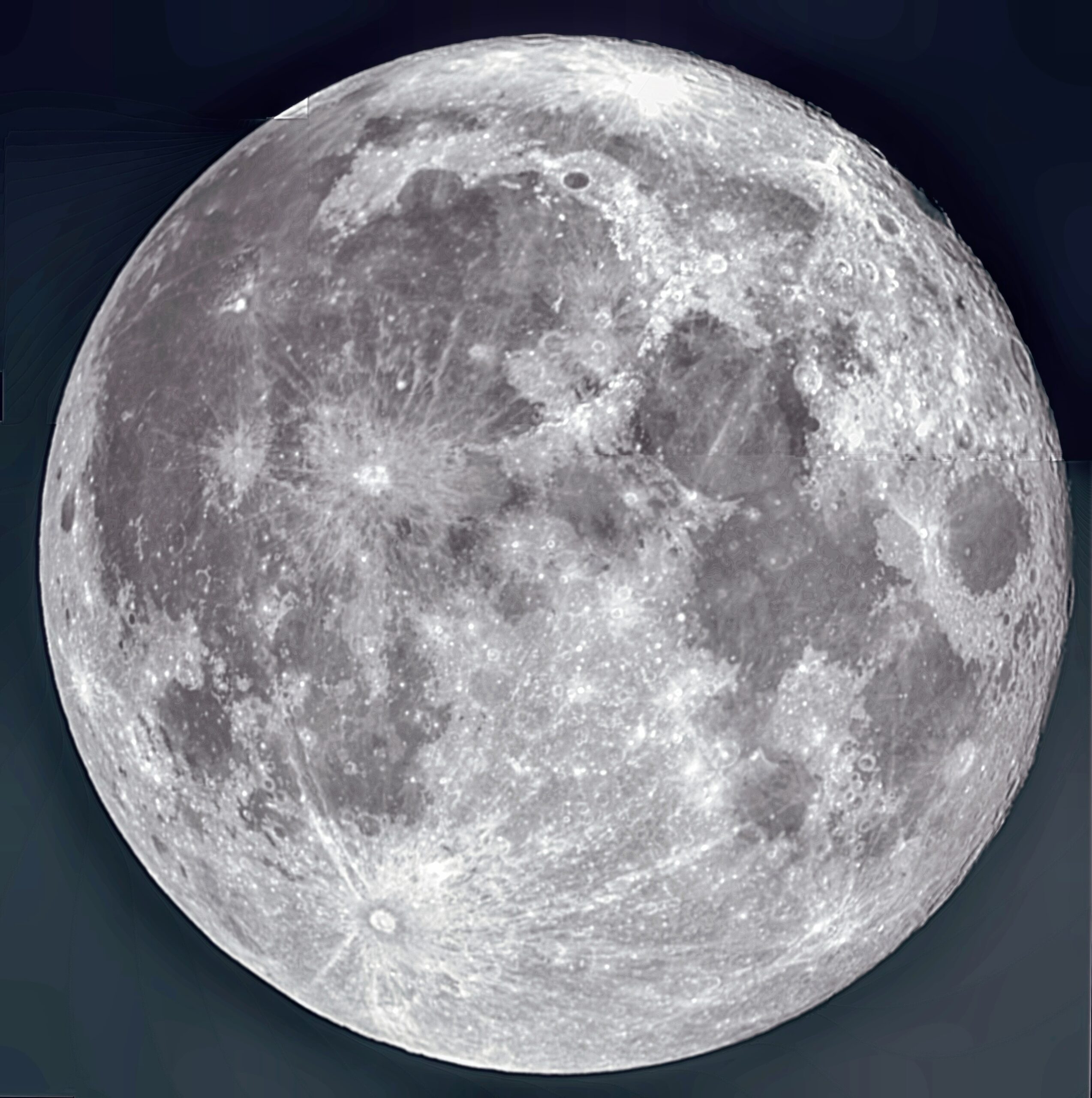
The Moon
This greenish portrait of the nearly full Moon emphasizes the dramatic contrast between bright cratered highlands and the darker maria that spread across much of the lunar near side. The image feels clean and immediate, with the round disk sharply isolated against black space and major ray systems clearly visible. Bright ejecta patterns from large impact craters draw the eye across the face of the Moon, while the darker lava plains provide large, recognizable shapes that balance the composition. The result is not simply a bright disk but a world with visible history written across its surface. The framing lets the Moon fill most of the field, making its geology feel tangible rather than remote. The Moon is Earth’s only natural satellite, with a diameter of 3,474 kilometers and an average distance of about 384,400 kilometers. It subtends about half a degree on the sky. The dark maria are basaltic plains formed by ancient volcanic flooding, while bright ray systems such as those from Tycho and Copernicus mark relatively younger impacts. The lunar surface preserves billions of years of bombardment and volcanic history.

Atlas and Hercules Craters
This compact high-contrast lunar frame isolates the Atlas and Hercules crater region against a dark background, emphasizing bright rims, shadowed interiors, and the sculpted relief of the surrounding terrain. The presentation feels observational and precise, using strong tonal contrast to make the crater walls and floors stand out with clarity. The scene is less about broad lunar geography and more about the beauty of local detail revealed by favorable illumination. Atlas and Hercules are prominent craters on the Moon’s northeastern near side. Their visibility changes strongly with the angle of sunlight, and high-resolution stacked imaging can reveal fine structure in rims, terraces, and floor detail that is otherwise difficult to see.

Partial Solar Eclipse
This image records the partial solar eclipse of April 8, 2024 as a bright golden solar crescent cut deeply by the advancing Moon. The dark bite taken from the Sun gives the event an immediate geometric drama, while the visible sunspot groups remind the viewer that this is a real, active star rather than a flat symbol. The simplicity of the composition is part of its power: one curved solar arc, suspended against black space, marking a precise celestial alignment between Sun, Moon, and Earth. Because the eclipse remained partial from Idaho, the solar disk was never fully covered, but the event still produced a striking change in shape and a memorable observational record. The sunspots add scale and texture, helping connect the image to the Sun’s changing magnetic activity as well as to the eclipse itself.