

Other
This section gathers objects that do not fit neatly into the other categories — striking deep-sky targets whose character or context places them on their own.
Albireo
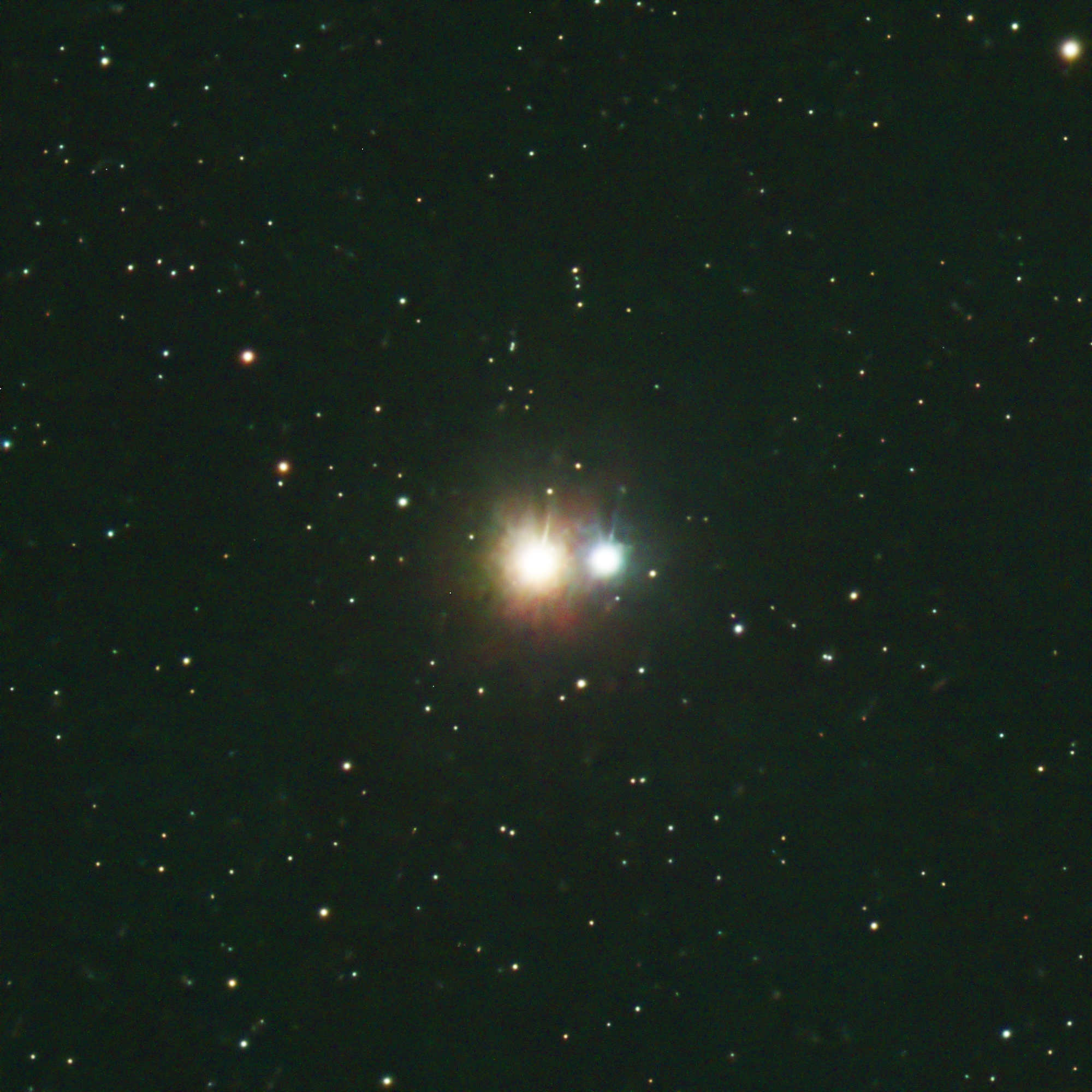
Albireo is one of the most beautiful sights in the entire telescopic sky. Marking the head of the Swan in Cygnus, it splits in any small telescope into two stars of vividly contrasting colour — a warm amber giant beside a hot blue companion. The contrast is so emphatic that it looks almost staged. Whether the two are truly bound together or simply a chance alignment along our line of sight is still debated, but for the eye at the eyepiece the answer hardly matters. Few pairs of stars are this generous with their light.
Albireo (β Cygni) is a visual double star marking the head of the Swan in the constellation Cygnus, located approximately 430 light-years from Earth. The brighter component, Albireo A, has an apparent magnitude of about 3.2 and shows a warm amber colour corresponding to its K-type giant spectral classification; the fainter component, Albireo B, has an apparent magnitude of about 5.1 and appears blue-white, consistent with its hot B-type spectral classification. The two stars are separated by approximately 35 arcseconds on the sky, an easy split in almost any telescope. Whether they form a true gravitationally bound binary has been debated; ESA’s Gaia parallax measurements indicate they do not share a common motion and are most likely a chance line-of-sight alignment rather than a physical pair. Albireo A is itself a spectroscopic binary, containing two close components separated by only a few astronomical units. The system is well placed for imaging through summer and early autumn in the northern hemisphere.
Personal commentary from George — coming soon. How the image was captured, what he likes about the result, and where he would like to take it next.
Western Veil Nebula
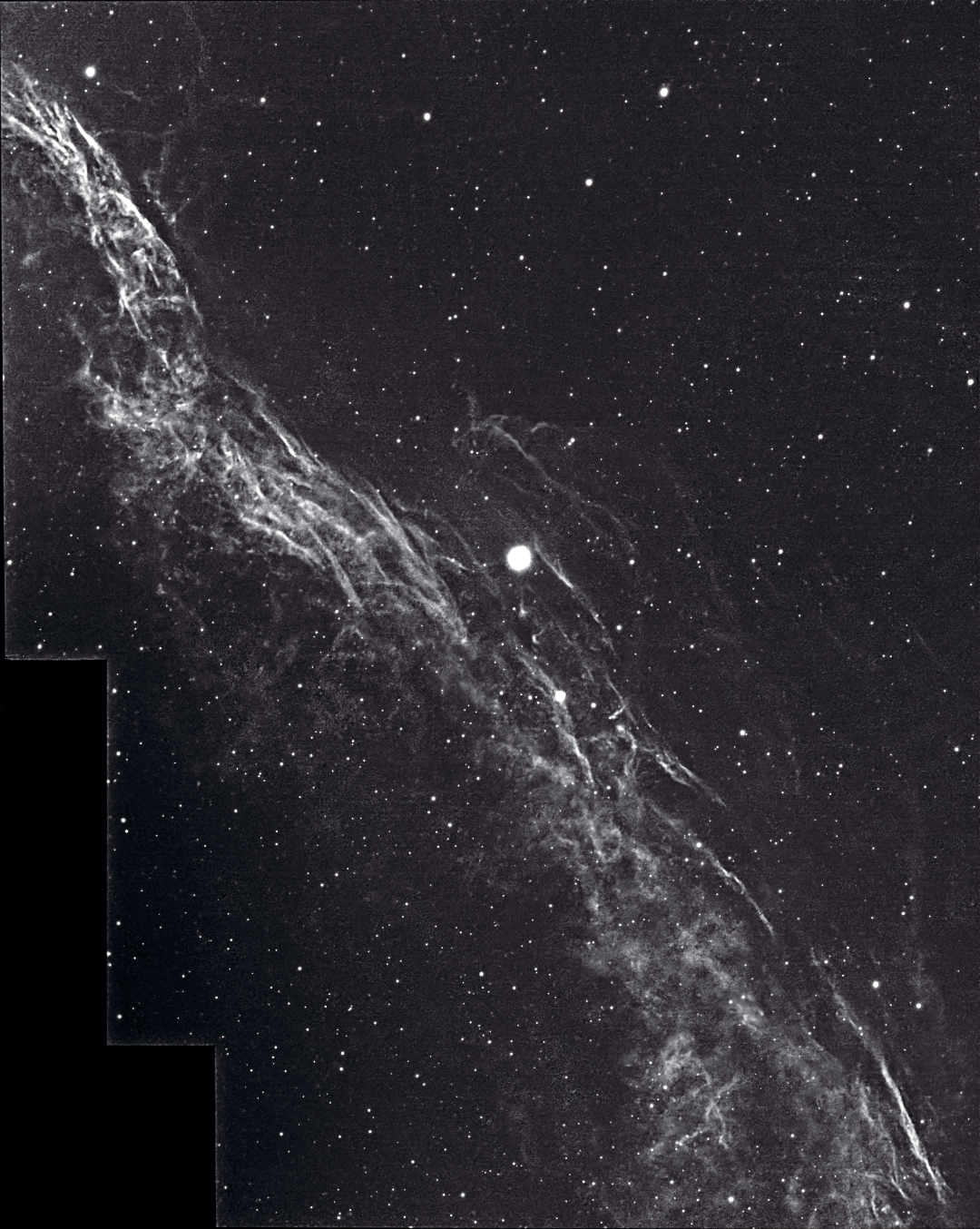
The Western Veil is a piece of the wreckage of a star that exploded ten thousand years ago and is still moving. It forms one curving side of the larger Cygnus Loop, delicate and impossibly thin in appearance, woven from filaments where the supernova’s expanding shock is still slamming into the interstellar medium at well over a hundred kilometres a second. There is something extraordinary about looking at it: a star’s violent death rendered, ten millennia later, as something that looks almost weather-like — a slow exhalation against the dark.
The Western Veil Nebula (NGC 6960, informally the Witch’s Broom) is part of the Cygnus Loop supernova remnant, located approximately 2,400 light-years away in the constellation Cygnus. The full Cygnus Loop spans roughly 3° on the sky, corresponding to a physical diameter of about 130 light-years. The Western Veil component crosses the bright foreground star 52 Cygni, which makes a convenient but physically unrelated visual anchor; 52 Cygni lies only about 200 light-years from Earth, well in front of the nebula. The supernova that produced the remnant is estimated to have occurred approximately 10,000 to 20,000 years ago and would, at peak, have rivalled the brightest stars in the sky for weeks. The visible filaments arise from shock fronts where the expanding ejecta are colliding with the surrounding interstellar medium at approximately 170 kilometres per second, with the emission dominated by Hα (red) and [O III] (cyan-green). The Veil is a textbook target for bicolour narrowband processing and is best imaged from northern summer through autumn.
This is my first deep-sky mosaic, captured on 13 May 2026 from the deck in Hidden Springs through the Celestron 14 EdgeHD with the ASI2600MM Pro. Three panels, each five two-minute subs, for roughly half an hour of light across the whole frame. The exercise wasn’t really about chasing depth so much as learning the discipline of tiling the sky cleanly: overlap, alignment, and gradient normalisation across the seams between panels. I kept it monochrome on purpose this time so the focus stayed on the mosaic process itself, without the added complexity of handling colour channels. The next attempt will be in colour, and I’d like to push the same skills a step further.
Crab Nebula (M1)
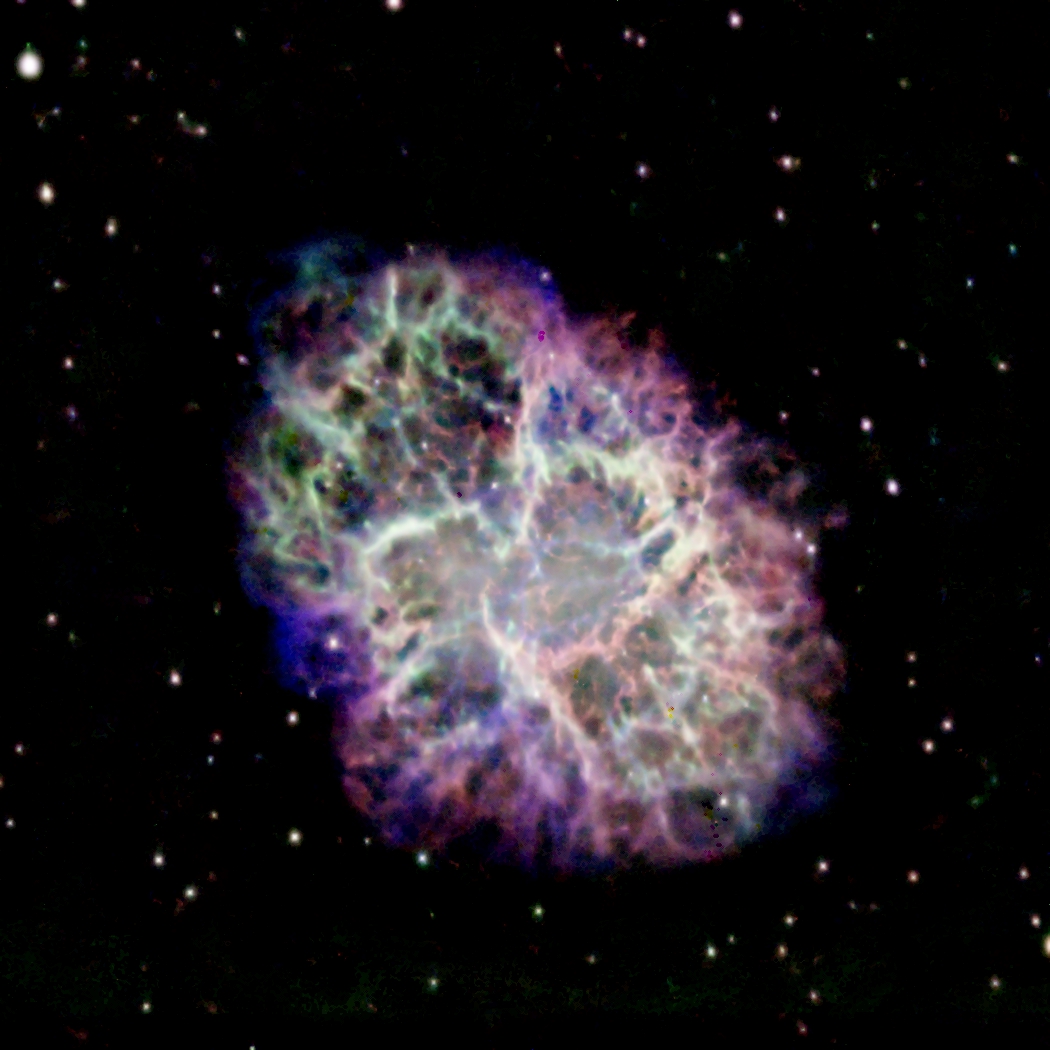
The Crab Nebula is one of the most extraordinary objects the night sky contains. In the year 1054 Chinese and Arab astronomers recorded a ‘guest star’ visible in daylight for weeks: a massive star exploding as a supernova. What they witnessed is still here, expanding outward at 1,500 kilometres per second and powered at its heart by a neutron star spinning thirty times every second. That tiny pulsar pours out the energy of nearly 150,000 Suns and lights the entire nebula by itself — a thousand-year-old explosion still in full progress.
The Crab Nebula, Messier 1 (NGC 1952), is the supernova remnant of SN 1054, located in the constellation Taurus at a distance of approximately 6,500 light-years. It has an apparent magnitude of about 8.4 and an angular size of roughly 6×4 arcminutes, corresponding to a physical diameter of about 11 light-years and still expanding at approximately 1,500 kilometres per second. At its centre is the Crab Pulsar (PSR B0531+21), a rapidly rotating neutron star spinning at 30.2 times per second, formed in the core-collapse supernova of a massive progenitor. The pulsar emits radiation across the entire electromagnetic spectrum — radio through TeV gamma rays — and powers the surrounding synchrotron nebula at a total luminosity of roughly 148,000 times the Sun, making it for decades the brightest persistent gamma-ray source in the sky. The nebula is measurably expanding from year to year and is the original entry on Charles Messier’s 1758 list of ‘things that are not comets’. Although the Crab is sometimes loosely grouped with emission nebulae, it is more properly a supernova remnant — specifically the canonical pulsar wind nebula, or ‘plerion’. The bulk of its light is non-thermal synchrotron radiation from electrons spiralling at relativistic speeds in the pulsar’s magnetic field, not the photoionised line emission that powers a true H II region or Wolf-Rayet shell. The orange-red filaments are genuinely line-emitting gas, but the diffuse bluish glow is something else again. For that reason we treat it here as a category of its own. It is best imaged from northern late autumn through early spring.
Messier Object Number One — you point a telescope at the Crab if you can. I gathered it across nine nights, 22 to 31 August 2025, from the deck of my apartment in Hidden Springs, through the Celestron 14 EdgeHD: 166 luminance subs, then 15 Hα, 15 OIII and 25 SII, all at sixty seconds — roughly three and a half hours total. The colour came out a little extreme in the end. What captivates me most isn’t the structure I caught, although there is plenty of it. It’s that the Crab glows by synchrotron radiation; most humans have never seen light from such a source. And it has visibly changed shape within human history.
Andromeda’s Parachute (J014709+463037)
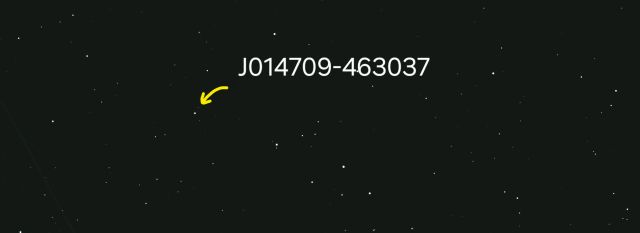
This is an object that almost certainly counts as the most distant thing on the entire site. Andromeda’s Parachute is the informal name for a quadruply-lensed quasar catalogued as J014709+463037, sitting in the constellation Andromeda. The quasar itself lies at a redshift of z = 2.377, which means its light set out roughly eleven billion years ago — well over two-thirds of the way back to the Big Bang, and long before the Sun, the Earth, or anything we recognise as our own neighbourhood existed. A foreground galaxy at about half that distance happens to sit almost exactly along the line of sight, and its gravity bends the quasar’s light into four separate images arranged in a small distinctive shape that, to its discoverers in 2017, looked like a parachute hanging in the sky. Under the conditions accessible to amateur equipment none of that geometry is resolved: the four images blur together into a single faint smudge, which is exactly what one would expect from a single point of light that has been travelling for eleven billion years to reach us. The arrow in the frame marks where it sits among the foreground field stars.
Andromeda’s Parachute (formally PS J0147+4630 / J014709+463037) is a gravitationally lensed broad-absorption-line quasar in the constellation Andromeda. The background quasar has a spectroscopically confirmed redshift of z = 2.377 ± 0.007, corresponding to a light-travel time of approximately eleven billion years (the present-day comoving distance, after cosmic expansion since emission, is closer to nineteen billion light-years). A foreground early-type galaxy at z ≈ 0.68 acts as the gravitational lens, splitting the quasar’s image into four components arranged in a trapezoid-plus-tail pattern that gives the object its informal name. The combined integrated magnitude is approximately V ≈ 15.5, which makes it one of the brightest known quad-lensed quasars at z > 2, but the four components are separated by only about three arcseconds, well below the resolution of typical amateur setups, so the source presents as a single faint star-like point on most images. The system was identified as a lensed quasar by Berghea and collaborators in 2017 from Pan-STARRS data and confirmed spectroscopically the same year using the Keck telescope. Captured on 5 April 2026 with the Celestron 14 EdgeHD and ASI2600MM Pro through a luminance filter only, 50 subs of 120 seconds each for 100 minutes of total integration.
This is by some distance the most remote target I have ever attempted. The object is around eleven billion light-years away, so the photons collected here set out before the Sun and the Earth existed, and the C14 collected them simply as a single faint point of light. There was no possibility, at this scale, of resolving the four lensed images that give the object its name — those components are separated by only a few arcseconds and would need a Barlow lens in the train and considerably more magnification to begin to tease them apart. That is the next experiment. For this attempt I was content just to register the source.