

Dwarf Planets
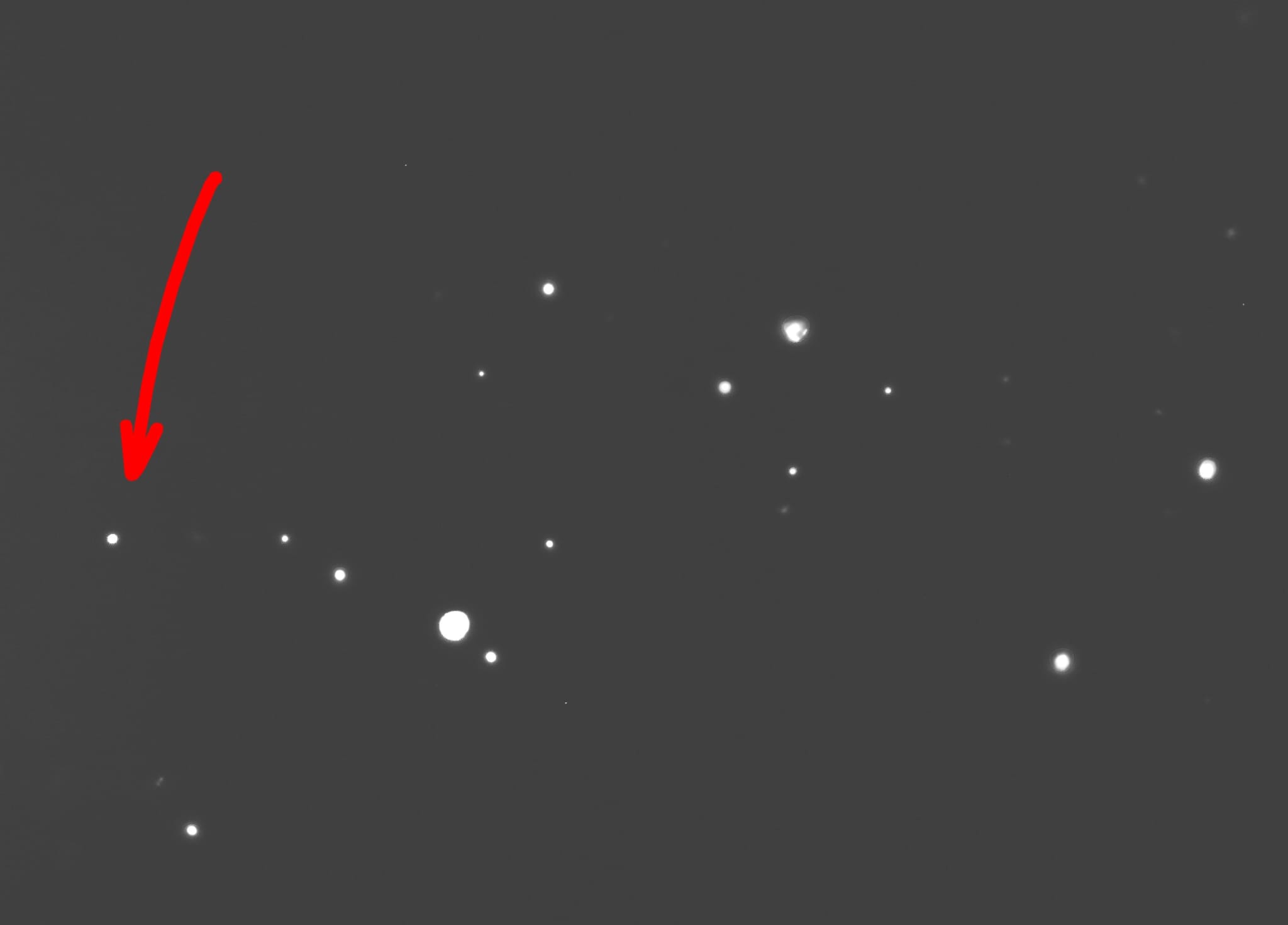
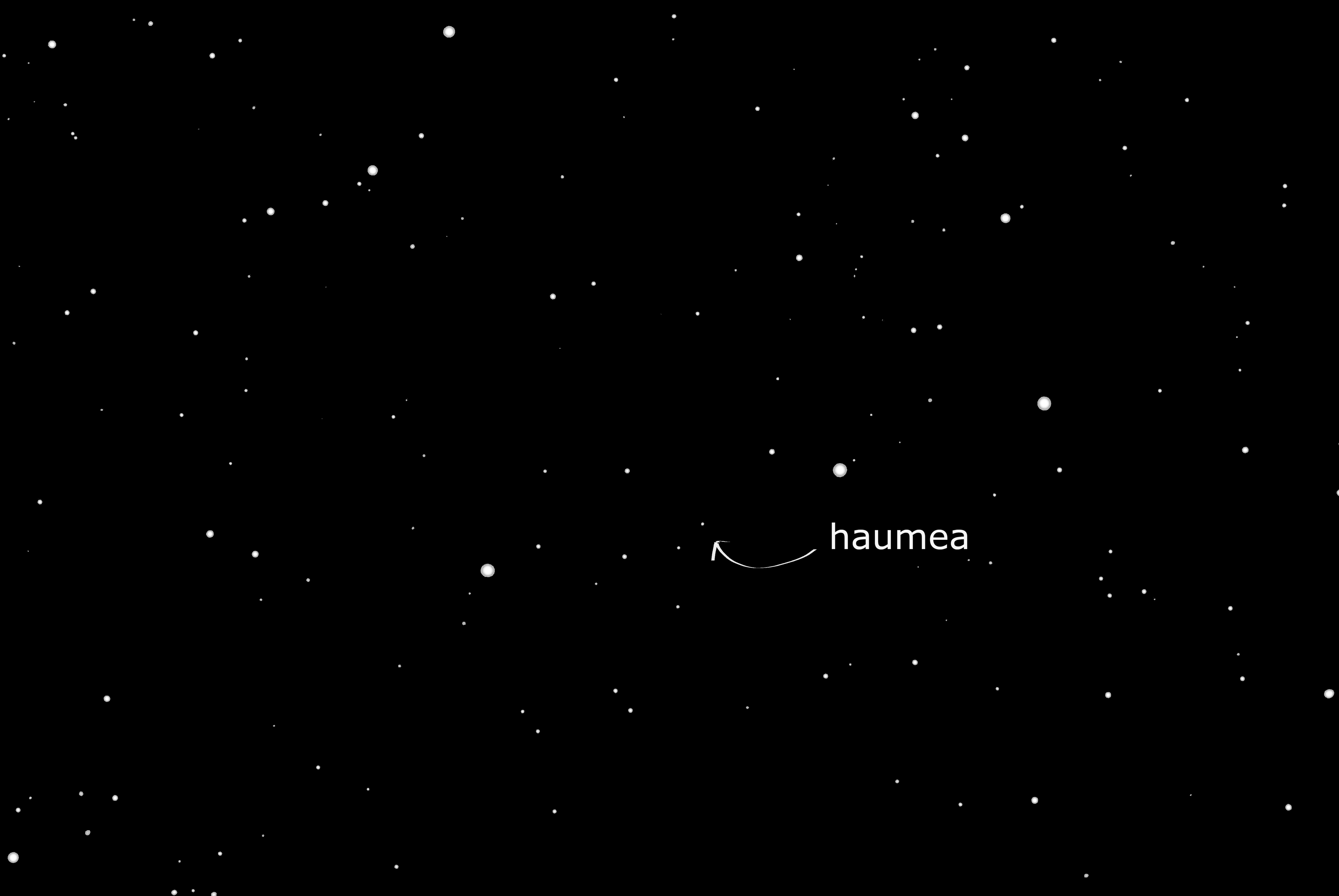
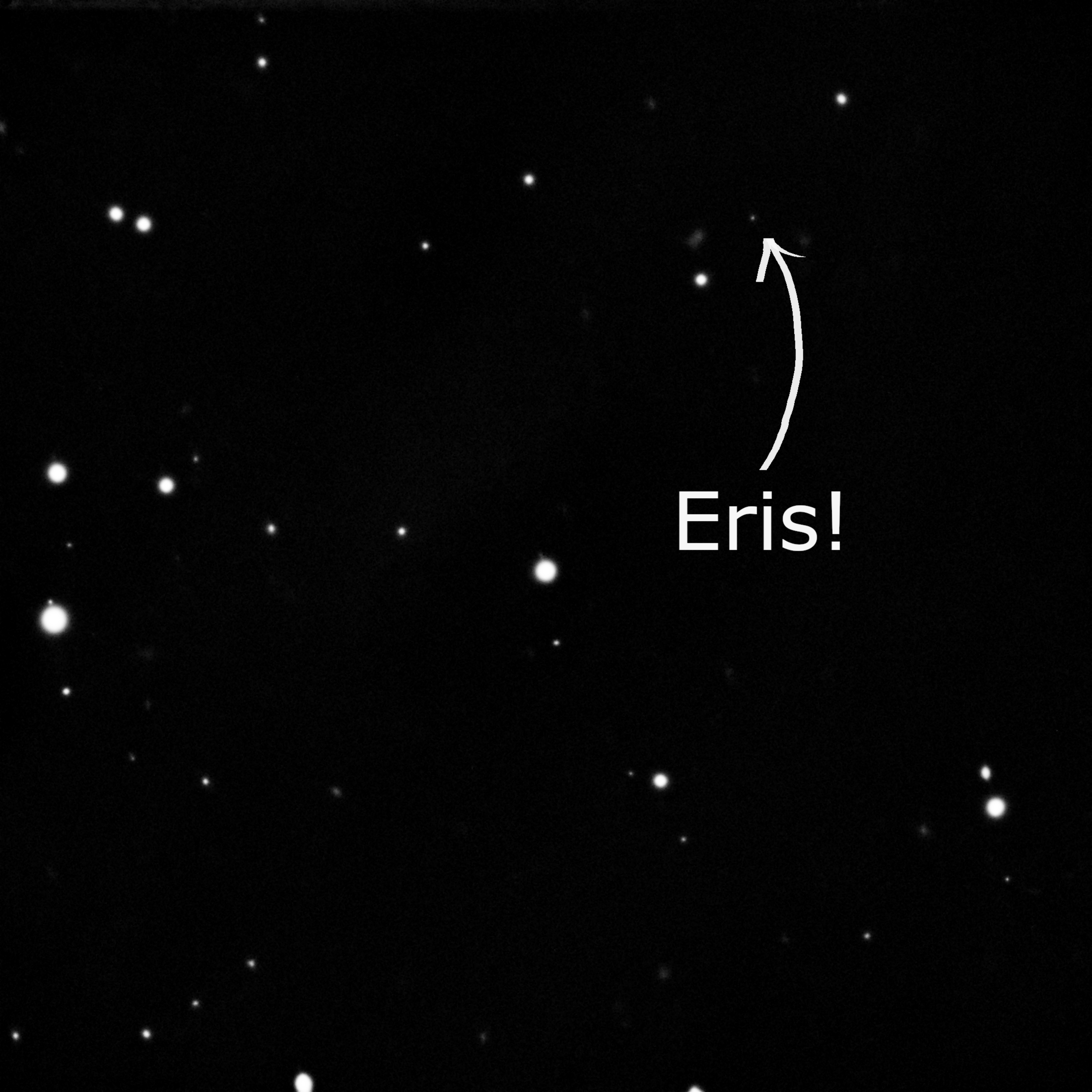
These images document some of the Solar System’s most distant recognized dwarf planets as faint points embedded in star fields. Their importance lies not in resolved surface detail but in successful detection, identification, and presentation of remote icy worlds far beyond Neptune.

Pluto
Pluto is the small, distant world that captured the public imagination throughout the twentieth century and then, in 2006, was quietly demoted from planet to dwarf planet by the International Astronomical Union. The 2015 New Horizons flyby utterly transformed our picture of it, revealing nitrogen-ice glaciers actively flowing across a vast heart-shaped basin, mountains of water ice three kilometres high, and a thin nitrogen atmosphere. Far from being the dead chip of rock it was once dismissed as, Pluto turned out to be one of the most geologically alive worlds in the entire solar system.
Pluto is a dwarf planet in the Kuiper Belt, the largest known trans-Neptunian object by volume and the second most massive after Eris. It has a diameter of 2,376 kilometres — about two-thirds the size of Earth’s Moon — and an orbital semi-major axis of approximately 39.5 astronomical units, with a period of 248 years. Its elliptical orbit (eccentricity 0.249) and 17° inclination occasionally bring it inside Neptune’s orbit; the two are nonetheless locked in a stable 3:2 mean-motion resonance and never collide. Apparent magnitude from Earth varies between about 13.6 and 16.3, making it challenging but reachable with amateur aperture and exposure. Pluto has five known moons: the large companion Charon (1,212 km), and the smaller Styx, Nix, Kerberos, and Hydra. The 2015 New Horizons flyby revealed actively flowing nitrogen-ice glaciers in Sputnik Planitia, water-ice mountains up to 3 kilometres high, and a tenuous nitrogen atmosphere. Pluto was reclassified from the ninth planet to a dwarf planet by the IAU in August 2006.
Personal commentary from George — coming soon. How the image was captured, what he likes about the result, and where he would like to take it next.
Makemake
Makemake is one of only five worlds the International Astronomical Union officially recognises as a dwarf planet, and one most people have never heard of. Named for a creator deity of the Rapa Nui people of Easter Island, it drifts through the cold outer reaches of the solar system, covered in red-tinted methane ice. No spacecraft has ever come close to it. To pull its faint, slow-moving point out of a field of background stars is a small, exact act of recognition: a private salute to one of the lonely outer worlds.
Makemake (formal designation 136472 Makemake) is a dwarf planet in the classical Kuiper Belt. It has a diameter of approximately 1,430 kilometres, making it the third-largest known trans-Neptunian object after Eris and Pluto. Its orbital semi-major axis is roughly 45.8 astronomical units, with an orbital period of about 306 years and a moderately high orbital inclination of 29°. Apparent magnitude from Earth is approximately 17.0, requiring serious aperture and tracked exposure to record as a point source. Makemake’s surface is dominated by frozen methane ice with reddish tholin deposits, giving it a distinctly red colour; spectroscopy also shows ethane and possible nitrogen ice. Unusually for a body of its size, no global atmosphere was detected during a 2011 stellar occultation, suggesting any nitrogen atmosphere is at most extremely tenuous. It has one known moon, S/2015 (136472) 1, nicknamed MK 2, discovered in 2015. Makemake was discovered in 2005 by Michael Brown’s team at Palomar Observatory and formally accepted as a dwarf planet by the IAU in 2008.
Personal commentary from George — coming soon. How the image was captured, what he likes about the result, and where he would like to take it next.
Haumea
Haumea is one of the strangest worlds the solar system contains. Spinning on its axis once every 3.9 hours — faster than almost anything its size — it has been physically stretched by its own rotation into an elongated, almost rugby-ball shape. Two small moons orbit it, and in 2017 astronomers discovered that it is surrounded by a thin ring of debris, the first ring ever found around any object in the outer solar system. For a body so distant and so faint, Haumea is an extraordinary collection of records.
Haumea (formal designation 136108 Haumea) is a dwarf planet in the Kuiper Belt, named for the Hawaiian goddess of fertility and childbirth. Its physical shape is markedly triaxial because of an extremely rapid 3.9-hour rotation period — the fastest known among large solar-system bodies — with approximate principal axes of 2,322×1,704×1,026 kilometres. Its mean diameter is roughly 1,560 kilometres (equivalent spherical). It orbits the Sun at a semi-major axis of about 43.3 astronomical units with a period of 285 years. Apparent magnitude is approximately 17.3. Haumea has two known moons, Hi’iaka and Namaka, and in 2017 a stellar occultation revealed a narrow ring of debris around the body — the first ring discovered around any trans-Neptunian object. Its surface shows strong water-ice spectra and an unusually high albedo near 0.7, comparable to fresh snow. Haumea is also the largest member of an entire collisional family of bodies, fragments thrown off by an ancient impact and now spread across similar orbits. It was discovered in late 2004 and formally accepted as a dwarf planet by the IAU in 2008.
Personal commentary from George — coming soon. How the image was captured, what he likes about the result, and where he would like to take it next.
Eris
Eris is the dwarf planet that rewrote the textbooks. Its discovery in 2005 forced the question ‘what is a planet?’ into the open: here was a body more massive than Pluto, orbiting three times further from the Sun, with its own moon and a mirror-bright surface of frozen atmosphere. The International Astronomical Union’s response in 2006 created the new category of dwarf planet and demoted Pluto along with it. Named for the Greek goddess of discord, Eris lived up to its name from the moment it was identified.
Eris (formal designation 136199 Eris) is a dwarf planet in the scattered disc of the outer solar system, named for the Greek goddess of strife and discord. Its diameter is approximately 2,326 kilometres, almost identical to Pluto, but it is about 27 percent more massive — making it the most massive known dwarf planet in the solar system. Its orbital semi-major axis is roughly 67.8 astronomical units, with a highly elliptical orbit (eccentricity 0.44) and high inclination of 44°; its orbital period is 558 years. Eris currently lies near aphelion at about 96 astronomical units, making it one of the most distant catalogued solar-system bodies. Its surface is one of the most reflective in the solar system, with an albedo near 0.96, comparable to fresh snow — most likely a thin layer of nitrogen and methane ice frozen out of a collapsed atmosphere. Apparent magnitude is approximately 18.7. It has one known moon, Dysnomia. Eris was discovered in 2005 by Michael Brown’s team and directly triggered the 2006 IAU vote that established the modern dwarf-planet definition.
Eris is part of a longer arc — to capture every dwarf planet, then push further into the Kuiper Belt to bodies not yet formally classified as such. At magnitude 18.7 and roughly 95 astronomical units from the Sun, Eris is the most distant Solar System object I have yet photographed. The image is far from aesthetic. It is a faint dot in a sparse field. But I watched that dot emerge live on my screen during the session, frame by frame, exactly where Cartes du Ciel said it ought to be. Knowing it had to be there, and then seeing it appear, is the thrill of making this image. The next milestone is Sedna.