

Emission Nebulae
These regions glow because energetic stars ionize surrounding gas, producing some of the richest color and structure in deep-sky astrophotography. They include star-forming complexes, shock fronts, and supernova remnants.
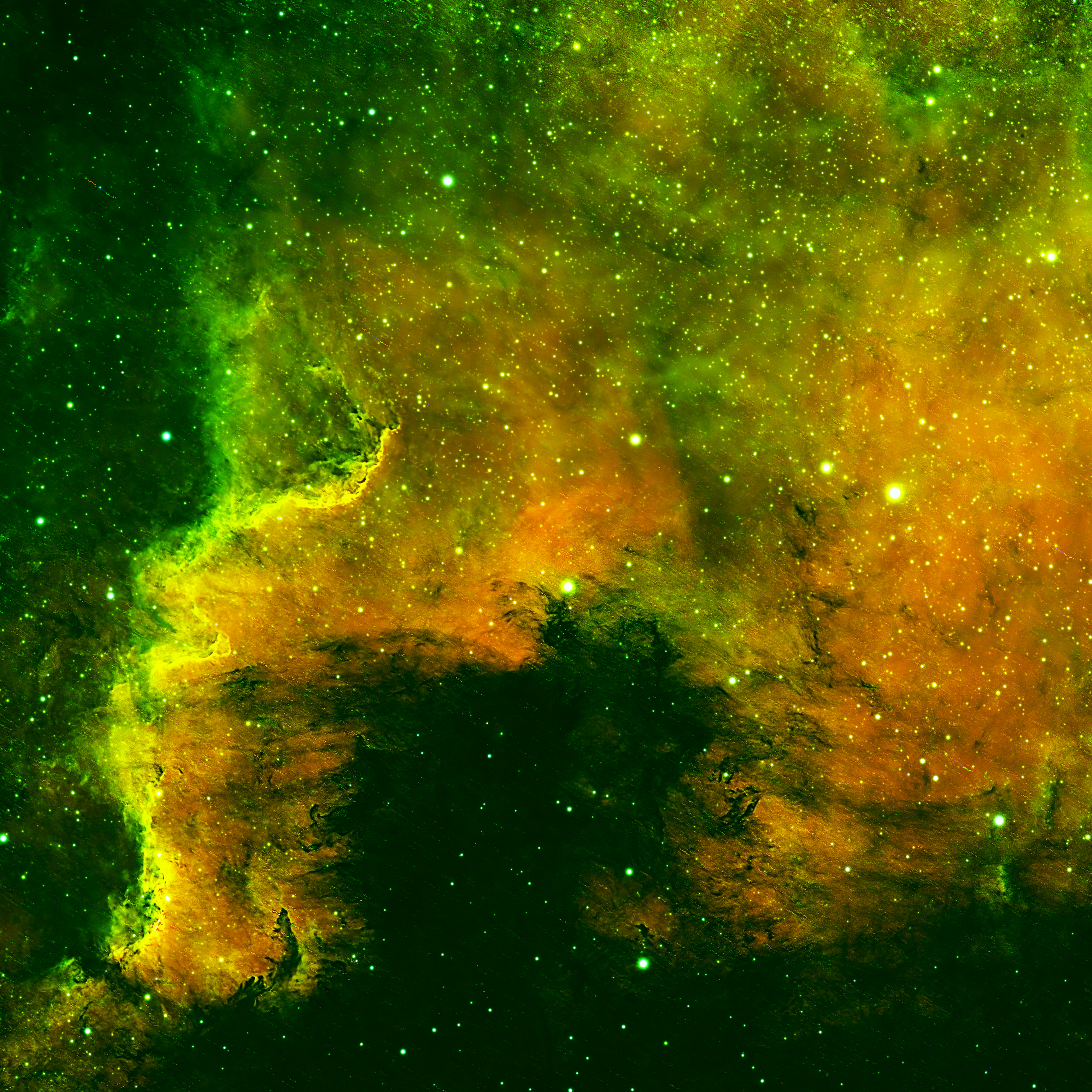
North America Nebula (NGC 7000)
The North America Nebula is one of those astronomical accidents that is hard to take entirely seriously: a vast cloud of ionised hydrogen happens, by pure coincidence, to trace out the eastern coastline of a continent on Earth. Hanging near the bright star Deneb in the heart of Cygnus, it spans more than four times the diameter of the full Moon. Behind the cartographic resemblance is a real stellar nursery, vast and patient, glowing under the ultraviolet light of stars we cannot even see because the dust gets in the way.
The North America Nebula (NGC 7000, Caldwell 20) is a large emission nebula in the constellation Cygnus, located approximately 2,600 light-years from Earth. It has an integrated apparent magnitude of about 4.0 and an angular size of roughly 120×100 arcminutes — more than four times the diameter of the full Moon — spanning about 90 light-years across. The nebula is excited by ultraviolet radiation from a hidden hot star, identified in infrared surveys as 2MASS J20555125+4352246, embedded behind the dust lane known as LDN 935. That dust lane is what produces the famous ‘Gulf of Mexico’ cut-out, separating NGC 7000 from the nearby Pelican Nebula (IC 5070); the two together once formed a single bright cloud now optically divided. The complex is part of a much larger H II region, with active star formation underway in several embedded protocluster regions. Narrowband Hα imaging brings out the layered rim structure along the ‘eastern seaboard’. The object is well placed for northern-hemisphere imaging from summer through autumn.
Personal commentary from George — coming soon. How the image was captured, what he likes about the result, and where he would like to take it next.
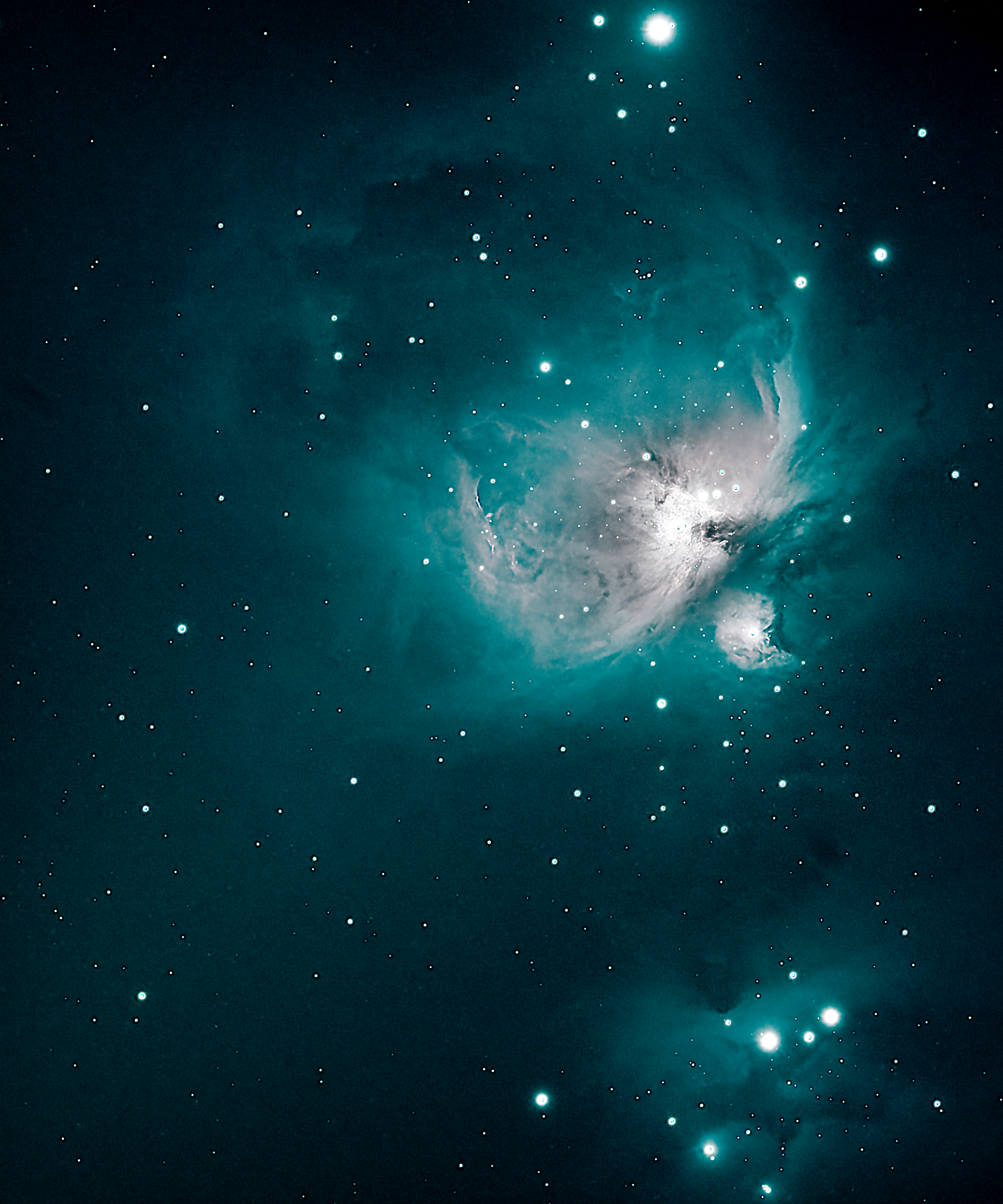
Great Nebula in Orion (M42)
Up close, the Great Nebula in Orion is one of the most intense sights in astronomy. At its heart sits the Trapezium, four hot young stars only about a million years old, pouring out so much ultraviolet light that they are lighting up, ionising, and steadily destroying the gas cloud that made them. Embedded in the inner glow are hundreds of protoplanetary discs — entire solar systems in the act of being assembled — individually resolved by Hubble. Few places in the sky are so concentrated with the physics of stellar birth.
Messier 42, the Great Nebula in Orion (NGC 1976), is a diffuse H II region located approximately 1,344 light-years from Earth, the nearest large star-forming region to the Solar System. The bright inner core surrounding the Trapezium Cluster (θ¹ Orionis) is ionised primarily by the ultraviolet output of θ¹ Orionis C, an O6V star with a luminosity of about 250,000 L⊙. The Trapezium itself is a young open cluster roughly 1–2 million years in age, containing several hundred stars within approximately 1.5 light-years of the central asterism. Embedded inside the inner nebulosity are hundreds of protoplanetary discs (‘proplyds’), individually resolved by the Hubble Space Telescope and now considered direct evidence that planetary systems form while their host stars are still being assembled. The integrated apparent magnitude of M42 is about 4.0, with the inner core easily visible to the unaided eye as the central ‘star’ of Orion’s sword. Close-up imaging benefits from high-dynamic-range stacking to preserve detail in both the Trapezium and the dimmer outer nebulosity. Orion is best imaged from northern late autumn through early spring.
Personal commentary from George — coming soon. How the image was captured, what he likes about the result, and where he would like to take it next.
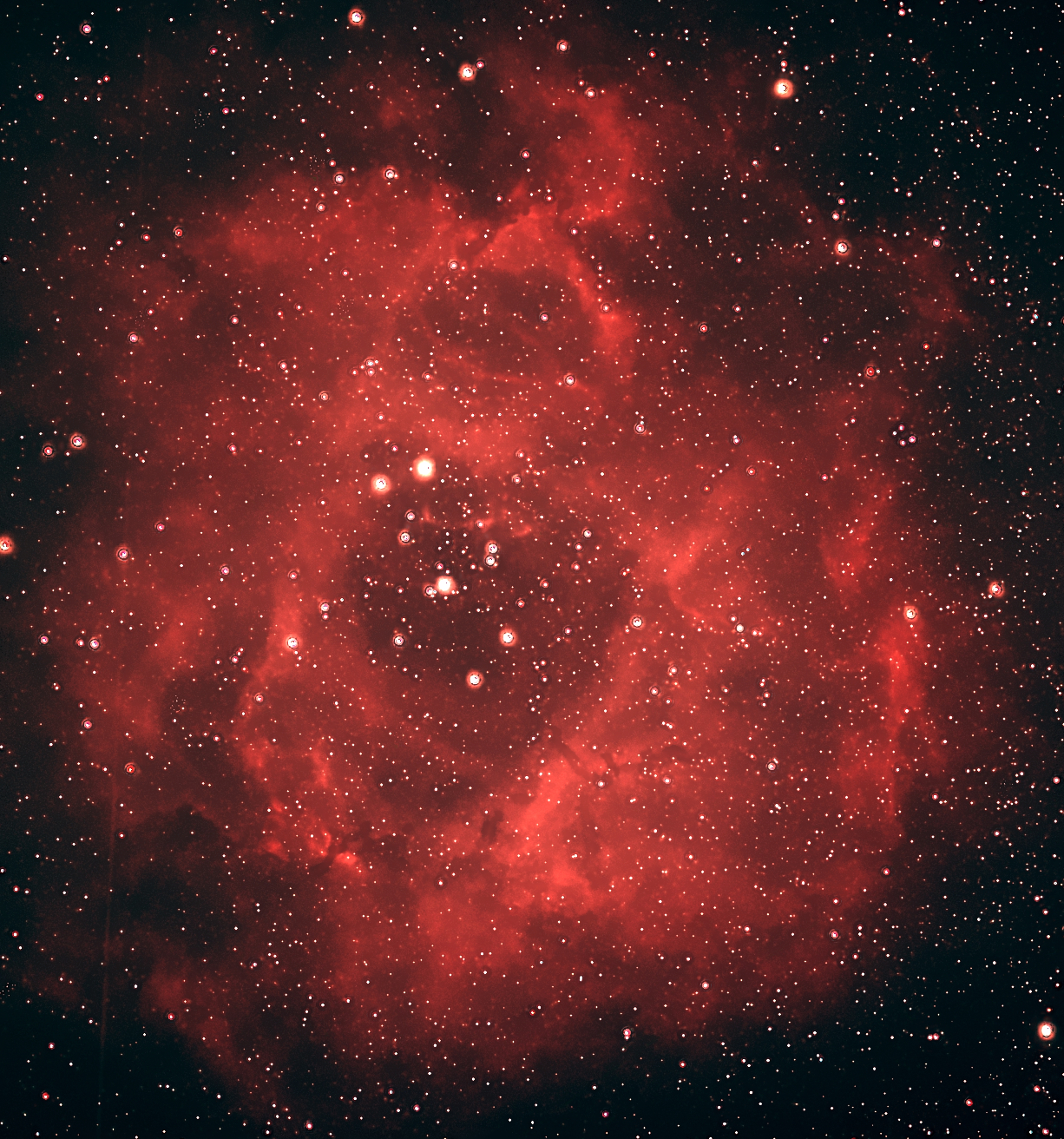
Rosette Nebula (NGC 2237–2246)
The Rosette is one of the most geometrically satisfying objects in the deep sky — a circular wreath of ionised hydrogen surrounding a hollow cavity, and at the centre of the cavity a brilliant young open cluster of hot stars whose winds and radiation are responsible for clearing it out. Around the inner rim, dark globules of unionised molecular gas are silhouetted against the bright background, every one a potential stellar nursery in its own right. The whole structure spans 130 light-years and weighs as much as ten thousand Suns.
The Rosette Nebula is a large H II region in the constellation Monoceros, located approximately 5,200 light-years away. The nebulosity is catalogued as several adjoining NGC entries (NGC 2237, NGC 2238, NGC 2239, NGC 2244, NGC 2246) and the central open cluster as NGC 2244. The whole structure spans roughly 1.3° on the sky, corresponding to about 130 light-years in physical extent. The cavity at the centre of the nebula has been cleared by intense ultraviolet radiation and stellar winds from the young, massive O- and B-type stars of NGC 2244, with an estimated cluster age of 2–6 million years. The total mass of the nebula is estimated at approximately 10,000 solar masses. Embedded along the inner rim are numerous dark globules of unionised molecular gas, sites of ongoing star formation. The Rosette is a strong X-ray source, with hot cluster winds shock-heating gas in the central cavity to temperatures of millions of kelvin. It is best imaged from northern late autumn through early spring.
Personal commentary from George — coming soon. How the image was captured, what he likes about the result, and where he would like to take it next.
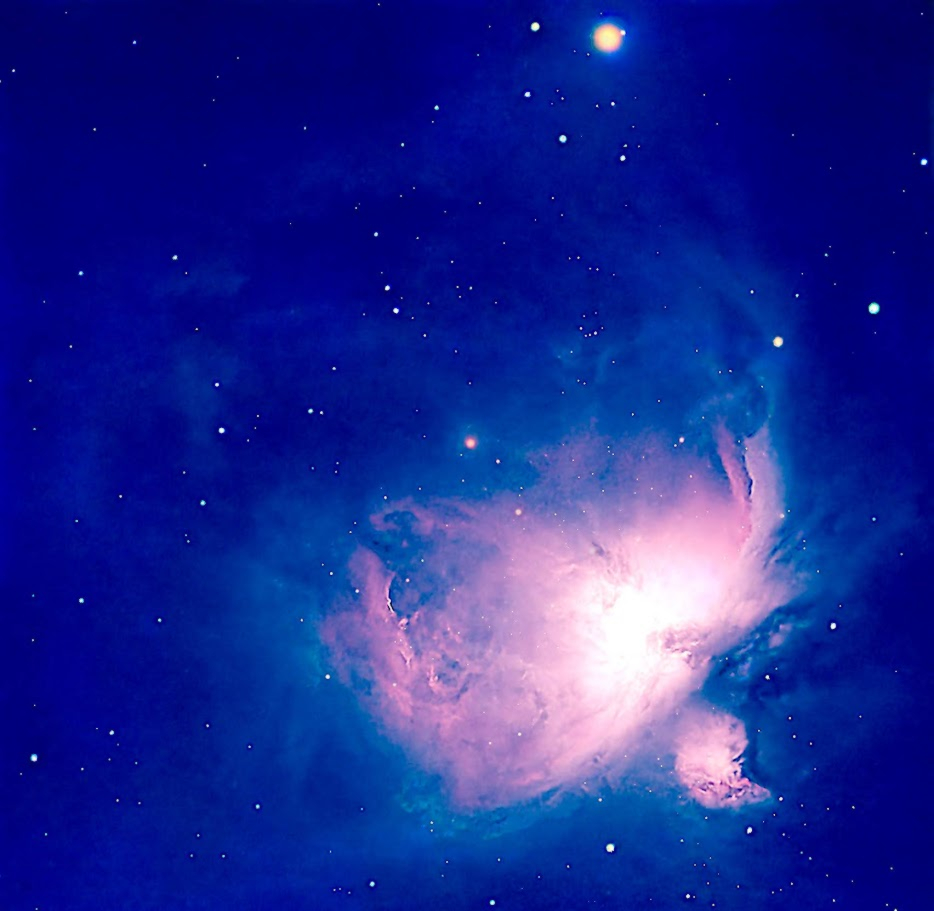
Great Nebula in Orion (M42)
Stand back from the Trapezium and Orion becomes a continent of glowing gas. The wide view of M42 takes in not only the bright core but the entire surrounding stellar nursery: the smaller northern lobe of M43, the colourful Running Man complex, and the dark intrusion known as the Fish’s Mouth that separates the brightest regions. All of it belongs to the same vast molecular cloud, and the gas visible here represents only the tip of a far larger reservoir that will go on producing stars for millions of years to come.
Messier 42 (NGC 1976), the Great Nebula in Orion, has a full angular extent of approximately 65×60 arcminutes — more than twice the diameter of the full Moon — corresponding to a physical diameter of around 24 light-years at its distance of 1,344 light-years. The wide-field view typically encompasses both M42 itself and its smaller northern companion Messier 43 (NGC 1982, De Mairan’s Nebula), separated by the dark dust intrusion known as the ‘Fish’s Mouth’. Further north lie the Running Man Nebula (Sh2-279, NGC 1973/1975/1977), a combined reflection and emission complex centred on the multiple star 42 Orionis. All three regions are part of the Orion Molecular Cloud 1 (OMC-1) complex and share a foreground distance near 1,344 light-years. The total estimated mass of ionised and molecular gas in the visible nebula is approximately 2,000 solar masses, and the wider Orion Molecular Cloud Complex contains around 200,000 solar masses of star-forming material — enough to build hundreds of thousands of new stars. The wide field is best imaged at short focal length from northern late autumn through early spring.
Personal commentary from George — coming soon. How the image was captured, what he likes about the result, and where he would like to take it next.
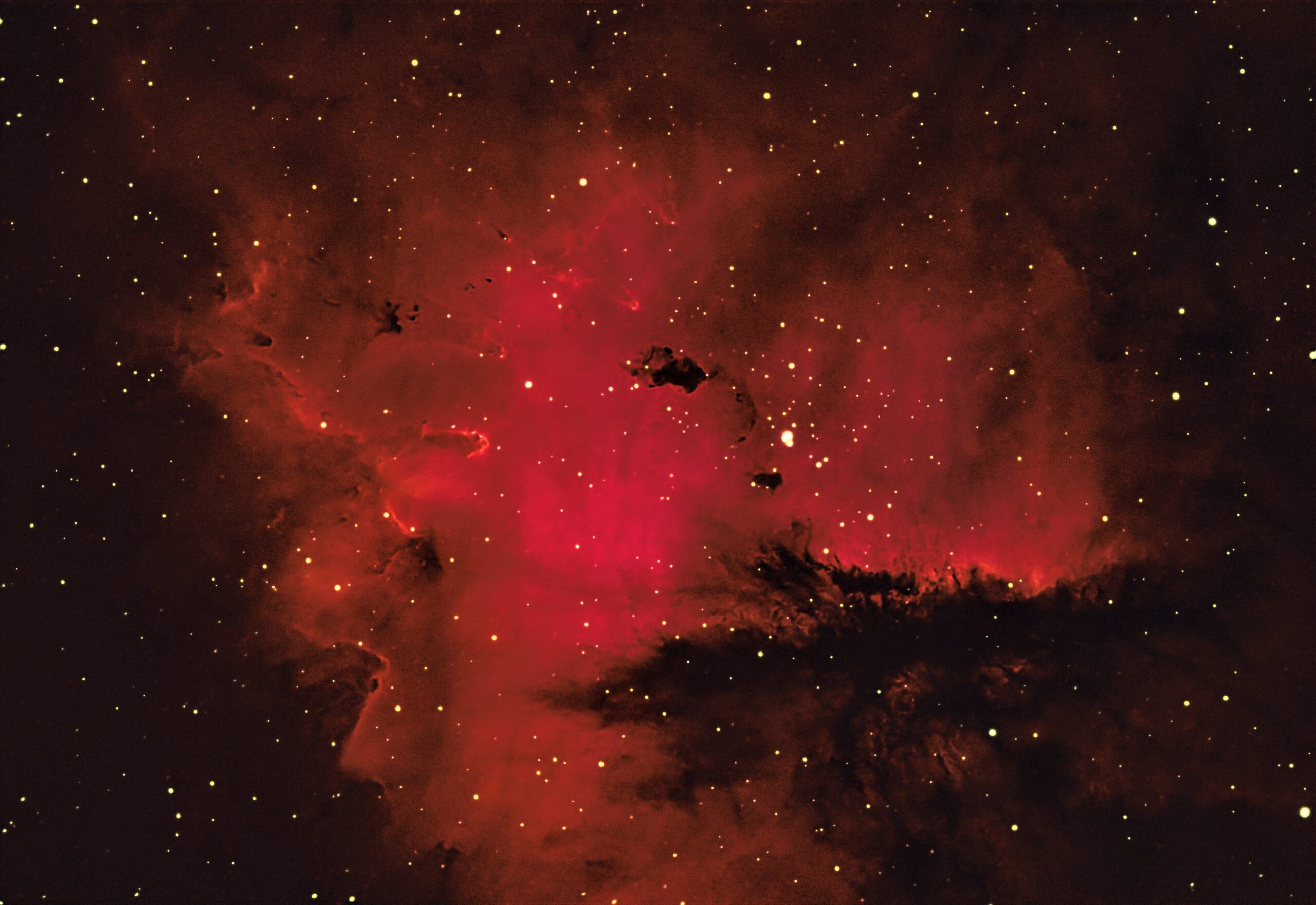
Pacman Nebula (NGC 281)
The Pacman is a real stellar nursery wrapped in a famous shape. A glowing disc of ionised hydrogen is cut into on one side by a wedge of dark dust, and the resemblance to a certain video-game character was inevitable enough to become its working name. The dark wedge is no joke, however: it is a complex of Bok globules, dense pockets of molecular gas being slowly photoevaporated by the hot young cluster at the centre of the nebula and currently in the process of giving birth to a new generation of low-mass stars.
The Pacman Nebula (NGC 281, Sharpless 2-184) is an H II region in the constellation Cassiopeia, located approximately 9,200 light-years from Earth in the Perseus spiral arm. It has an integrated apparent magnitude of about 7.4 and an angular size of roughly 35×30 arcminutes, corresponding to a physical diameter of about 95 light-years. The nebula is ionised by the open cluster IC 1590 embedded near its centre, whose brightest member is the multiple star HD 5005, a system dominated by an O6V primary. The dark ‘mouth’ of the Pacman shape is produced by a complex of foreground Bok globules, sites of ongoing low-mass star formation that are being slowly photoevaporated by ultraviolet radiation from the central cluster. The system has been studied extensively as a textbook example of triggered star formation, where massive stars carve out a cavity that compresses surrounding gas and seeds new collapse. Narrowband Hα, [O III], and [S II] imaging brings out particularly rich filamentary detail across the bright western edge. The object is well placed for northern-hemisphere imaging from late summer through winter.
Personal commentary from George — coming soon. How the image was captured, what he likes about the result, and where he would like to take it next.
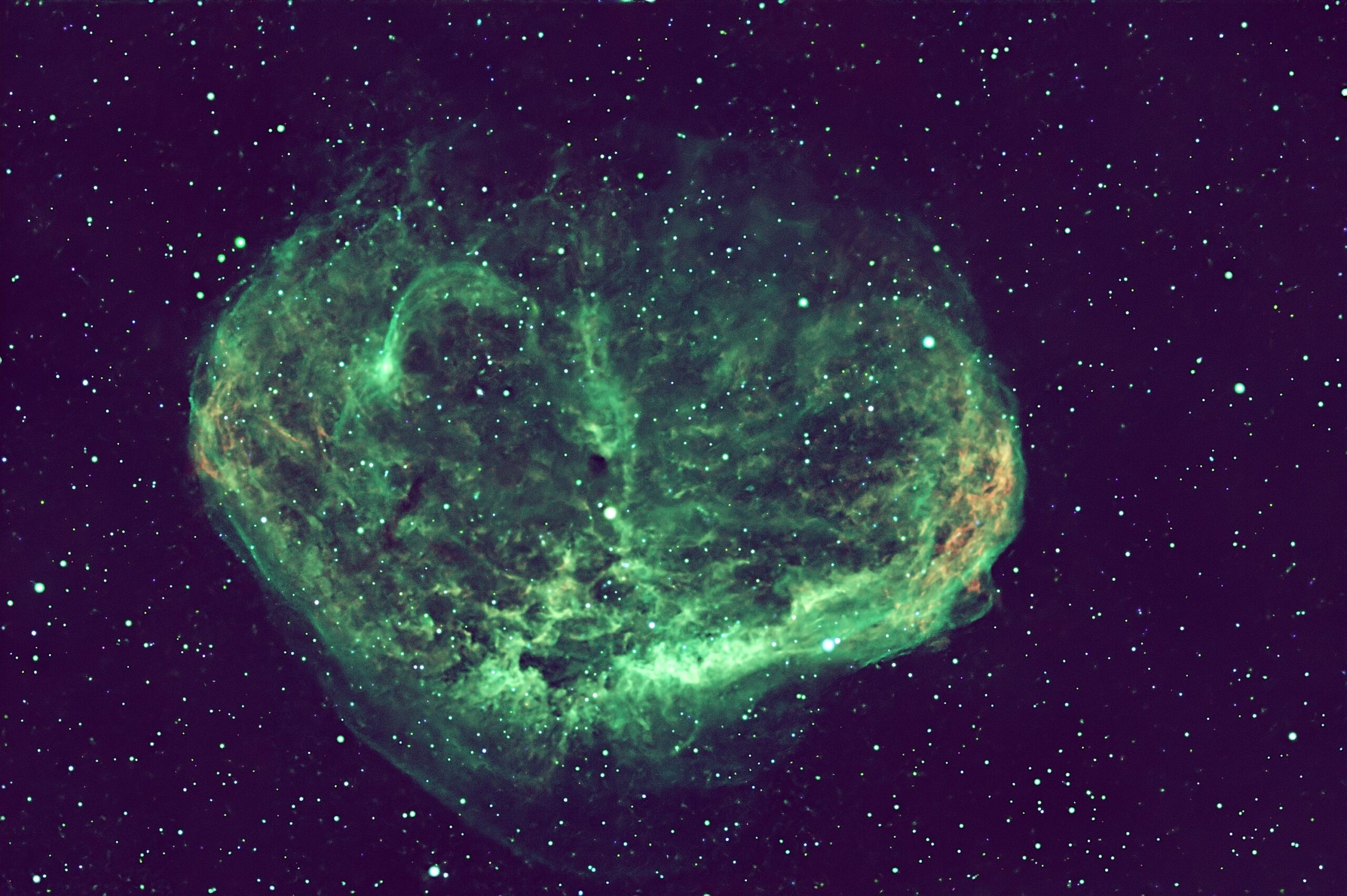
Crescent Nebula (NGC 6888)
The Crescent Nebula is the visible autobiography of a dying star. The central object, a hot Wolf-Rayet star called WR 136, is one of the rarest and most short-lived kinds in the galaxy — the bare, exposed core of a once-massive star, shedding its outer layers in a high-speed wind that is slamming into and sweeping up the slower envelope it ejected earlier in its life. The result is the bright curved shell we see today, and the star is on track to end as a supernova in only a few hundred thousand more years.
The Crescent Nebula (NGC 6888, Caldwell 27) is an emission nebula in the constellation Cygnus, located approximately 4,700 light-years away. It has an apparent magnitude of about 7.4 and an angular size of roughly 18×12 arcminutes, corresponding to a physical diameter of about 25 light-years. The nebula is a wind-blown shell formed by the fast stellar wind of the central Wolf-Rayet star WR 136 (HD 192163) sweeping up and shocking material previously ejected during the star’s red-giant phase approximately 250,000 to 400,000 years ago. WR 136 is a WN6 spectral-type Wolf-Rayet star with a present-day mass near 15 solar masses and a surface temperature above 70,000 K; it is expected to end its life in a core-collapse supernova within the next few hundred thousand years. Wolf-Rayet stars are extremely rare — only around 600 are catalogued in the whole Milky Way — and the Crescent is one of the most accessible examples of the surrounding nebulae they produce. At a glance NGC 6888 looks very like a planetary nebula — a roughly shell-shaped cloud illuminated from within by a single hot blue star — but it is not one. Planetary nebulae are ejected by intermediate-mass stars at the end of their lives and are lit by the small, hot white dwarfs they leave behind. The Crescent is the cast-off envelope of a far more massive star heading not for a white-dwarf retirement but for a supernova; the central object is a still-living Wolf-Rayet, not a stellar remnant. By convention it is classified as a Wolf-Rayet, or wind-blown, emission nebula. Bicolour Hα and [O III] narrowband imaging highlights the contrasting inner shock and outer ionisation structure. It is best imaged from northern summer through autumn.
Cygnus high overhead and the Crescent sitting up obligingly from the balcony in Hidden Springs. Through the Celestron 14 EdgeHD I gathered narrowband — Hα and OIII at two minutes each, sixteen or seventeen of each, fewer SII, plus a couple of luminance frames for brightness — about an hour total on 23 April. Still close to my state of the art. What pleases me most is the clean segmentation from the background: proper reduction has worked beautifully. The palette puts hydrogen into green, which gives the image its eerie cast — next time I’d weight more toward oxygen and sulphur and rebalance. The bubble shape is irresistibly compelling; this will be a hardy annual.
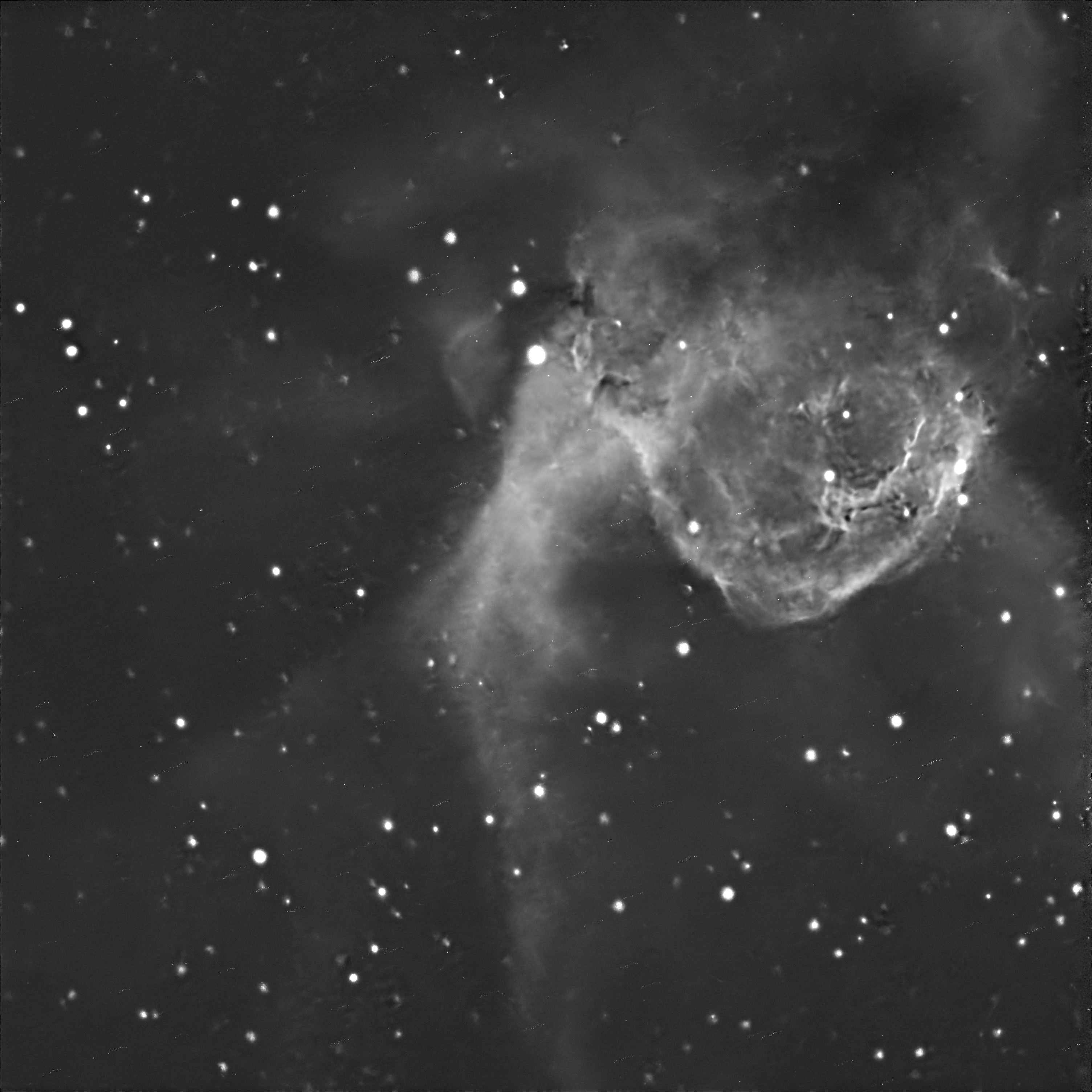
Duck Nebula Region
The wider region around the Tulip Nebula in Cygnus is one of the busiest patches of star-forming sky anywhere in the northern hemisphere. The bright nebulosity is set against the immense Cygnus X molecular cloud, the most active stellar nursery within a few thousand light-years of Earth. Tucked into the same field, almost invisibly, is the famous X-ray binary Cygnus X-1, host to the first stellar-mass black hole ever identified. Few frames in astrophotography manage to combine quite so much glowing gas, hidden mass, and quiet astrophysical celebrity in a single shot.
The ‘Duck Nebula’ is an informal name applied to a region of emission nebulosity in Cygnus whose outline suggests a swimming bird; the most common identification is the bright nebula complex around the Tulip Nebula (Sharpless 2-101). Sh2-101 lies at a distance of approximately 6,000 light-years and is ionised by the hot O-type star HDE 227018; it spans roughly 16×9 arcminutes on the sky. The wider field encompasses portions of the Cygnus X complex, one of the most active star-forming regions in the Milky Way and a source of strong gamma-ray emission. The region also includes the X-ray binary Cygnus X-1, the first stellar-mass black-hole candidate identified in the early 1970s; it consists of a blue supergiant (HDE 226868) in close orbit with a compact object of roughly 21 solar masses. Narrowband Hα and [O III] imaging brings out the layered ionisation rims of the brighter clouds and the wispy filamentary structure of the surrounding interstellar medium. The region is best imaged from northern summer through autumn.
Personal commentary from George — coming soon. How the image was captured, what he likes about the result, and where he would like to take it next.
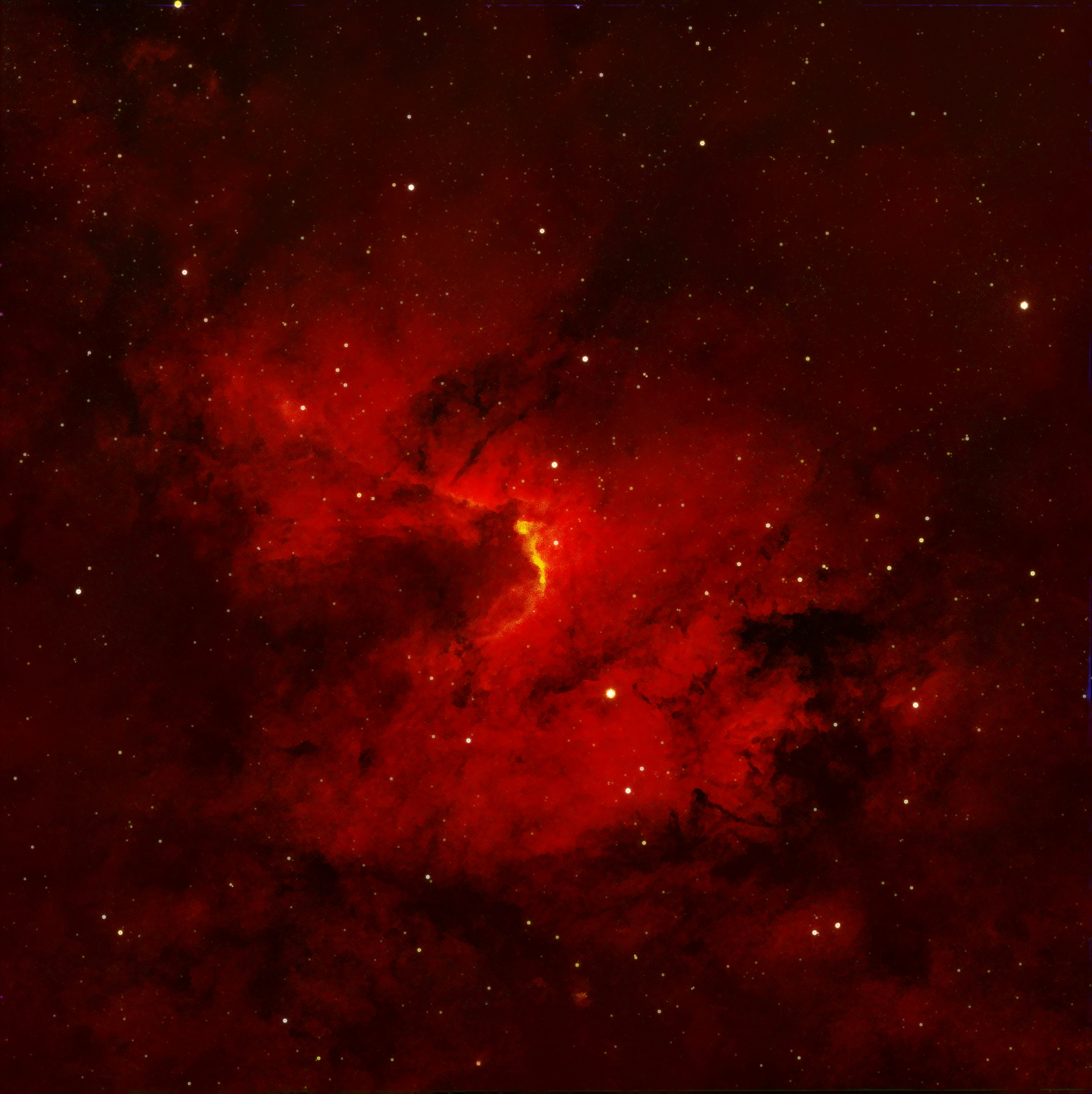
Cave Nebula Region (Cederblad 214)
Cederblad 214 is a vast sheet of glowing hydrogen in Cepheus, near the boundary of the famous Cave Nebula, and it is one of the under-photographed wonders of the northern sky. Inside it sits the young open cluster NGC 7822, whose hot stars are responsible for ionising the gas and sculpting it into rugged bright-rimmed pillars where new stars are still being born. The whole complex is dozens of light-years across and a working factory of stellar assembly — the kind of region the Milky Way builds itself out of.
Cederblad 214 is a large emission nebula in the constellation Cepheus, part of the bright H II region complex Sharpless 2-171 and physically associated with the young open cluster NGC 7822. The complex lies at a distance of approximately 2,900 light-years and spans roughly 1° on the sky, corresponding to about 50 light-years across. The hottest member of NGC 7822, BD+66°1673, is one of the most luminous O-type stars within a few thousand light-years and is the principal source of ionising radiation. The Cave Nebula component, catalogued as Sh2-155 (Caldwell 9), is a smaller and slightly nearer reflection-and-emission nebula about 2,400 light-years away, often framed in the same wide-field image; the Sh2-155 cavity is illuminated and partly evacuated by hot young stars of the Cepheus OB3 association. The region is a site of active star formation, with multiple bright-rimmed globules and embedded young stellar objects visible in narrowband and infrared imaging. The complex is best imaged from northern summer through autumn, when Cepheus stands near the zenith.
Personal commentary from George — coming soon. How the image was captured, what he likes about the result, and where he would like to take it next.
NGC 1931
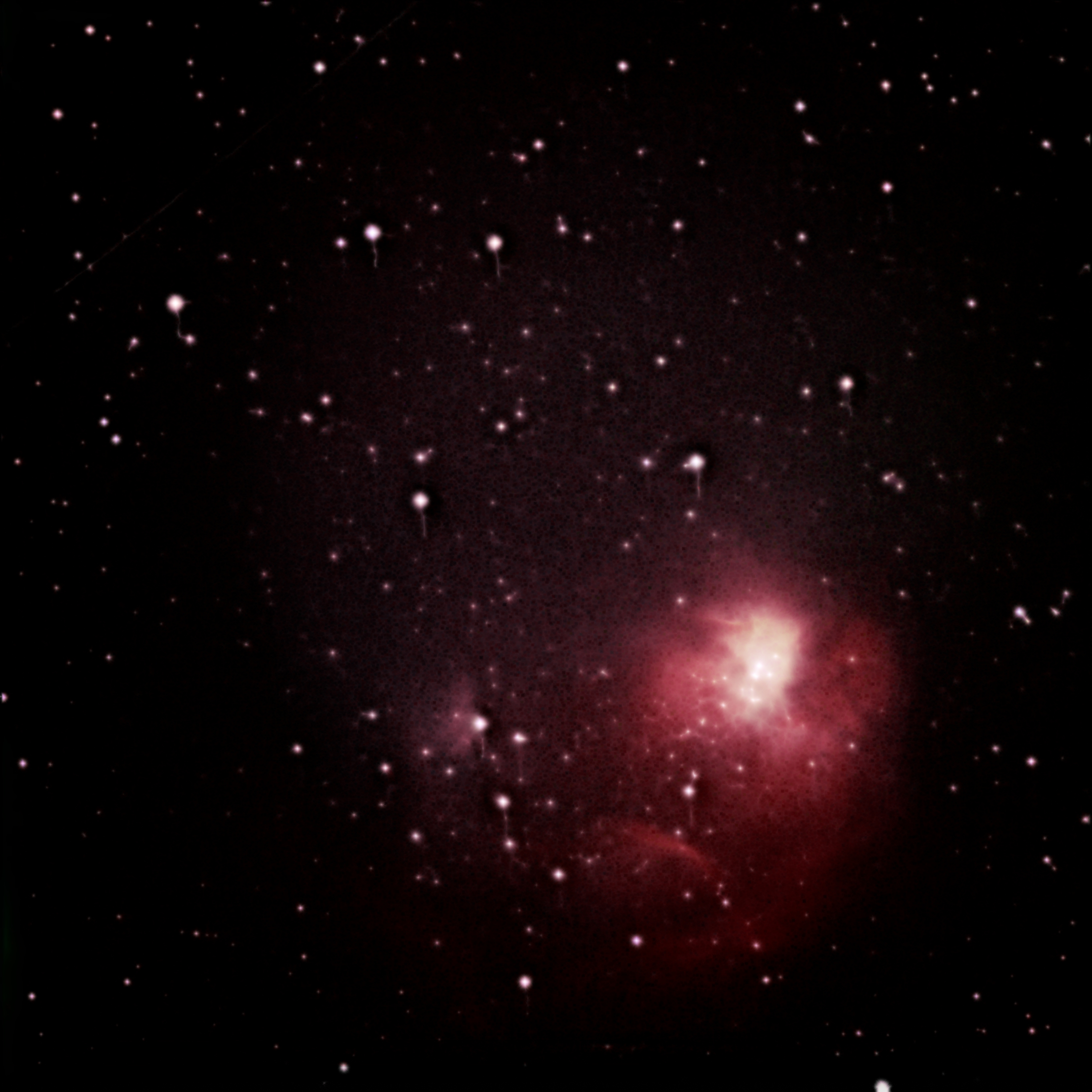
NGC 1931 is a quiet little stellar nursery that hides in plain sight, overshadowed by the more famous winter targets around it. Inside its compact glow sits a tight knot of young, hot stars arranged in a pattern so reminiscent of the Trapezium at the heart of M42 that it has earned the nickname Miniature Trapezium. Combined emission and reflection nebulosity wraps the cluster in pink and blue, a single self-contained star-formation event still in progress — a small world building itself, ten thousand light-years away.
NGC 1931 is a combined open cluster and emission/reflection nebula in the constellation Auriga, located approximately 10,000 light-years away. It has an integrated apparent magnitude of about 10.1 and an angular size of roughly 3 arcminutes, corresponding to a physical diameter of about 10 light-years. The central cluster contains roughly a dozen young, hot stars, the brightest of which are visually arranged in a compact pattern reminiscent of the Trapezium in M42 — hence the informal nickname ‘Miniature Trapezium’ or ‘Fly Nebula’. The cluster is enclosed within a characteristic combined H II region (ionised emission) and reflection nebulosity, with bluish scattered light dominating around the bright central stars and red Hα emission extending around the periphery. NGC 1931 is estimated to be only about 10 million years old, a very young stellar cluster still embedded in part of its parental molecular cloud. The object is well placed for northern-hemisphere imaging from late autumn through early spring.
Personal commentary from George — coming soon. How the image was captured, what he likes about the result, and where he would like to take it next.
Bubble Nebula (NGC 7635)
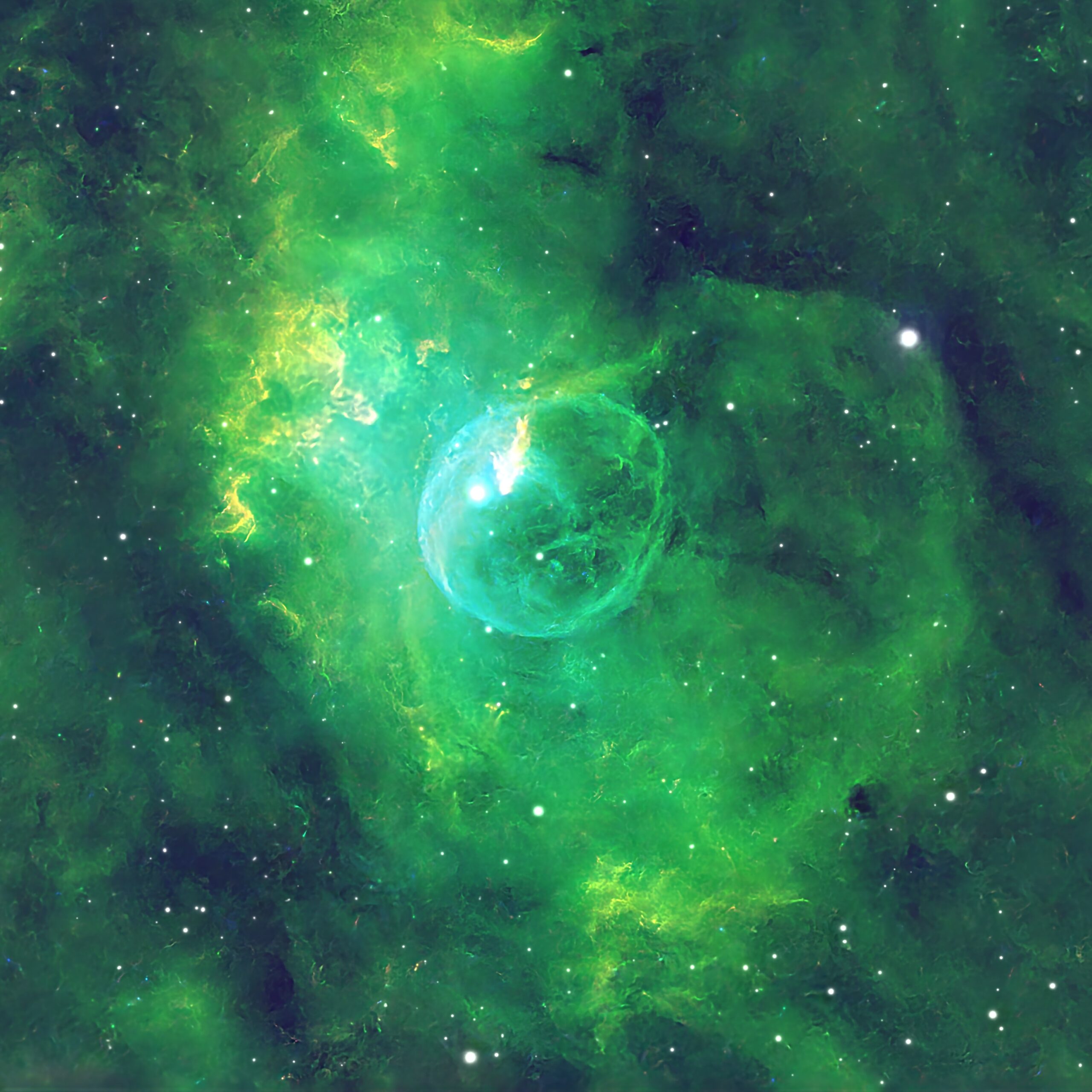
The Bubble Nebula is one of the more theatrical objects in the northern sky. A near-perfect spherical shell about ten light-years across hangs off-centre inside a much larger complex of glowing hydrogen, blown outwards by the fierce stellar wind of a single massive young star at its heart. The surrounding emission filaments wrap around the bubble in great curtains and ribbons. The whole scene reads as a snapshot of stellar feedback in action — a star actively pushing back against the cloud that bore it.
The Bubble Nebula (NGC 7635) is an H II region and wind-blown emission nebula in the constellation Cassiopeia, located approximately 7,100 light-years from Earth. The defining feature is a near-spherical shell roughly 7 to 10 light-years in diameter, inflated by the powerful stellar wind and ionising radiation of the central O-type star SAO 20575 (BD+60°2522), an extremely hot, massive young star with an estimated mass of 10–40 solar masses. The bubble itself is embedded asymmetrically within a much larger molecular cloud complex, which the expanding shell is actively compressing. NGC 7635 was discovered by William Herschel in 1787. The nebula has an integrated apparent magnitude of about 10 and an apparent angular size of roughly 15 × 8 arcminutes. It is well placed for northern-hemisphere imaging during late summer and autumn, when Cassiopeia rides high overhead.
I had not planned on the Bubble Nebula. I noticed it while thinking about what else might sit nicely in the C14 field of view, and it fitted almost perfectly. The image came out rather better than I had expected. What was actually new for me here was the processing order. I have always run BlurXTerminator before any noise reduction, on the basis that you sharpen first and clean up afterwards. This time, on a whim, I reversed it and reduced the noise first. The effect on the Wolf-Rayet bubble itself was noticeable — the spherical shell looks cleaner and more coherent, and the sharpening had something less noisy to work with.