

Solar System
These images focus on nearby objects within our own celestial neighborhood, where changing illumination and high-resolution detail reveal geology and topography rather than deep-sky structure.
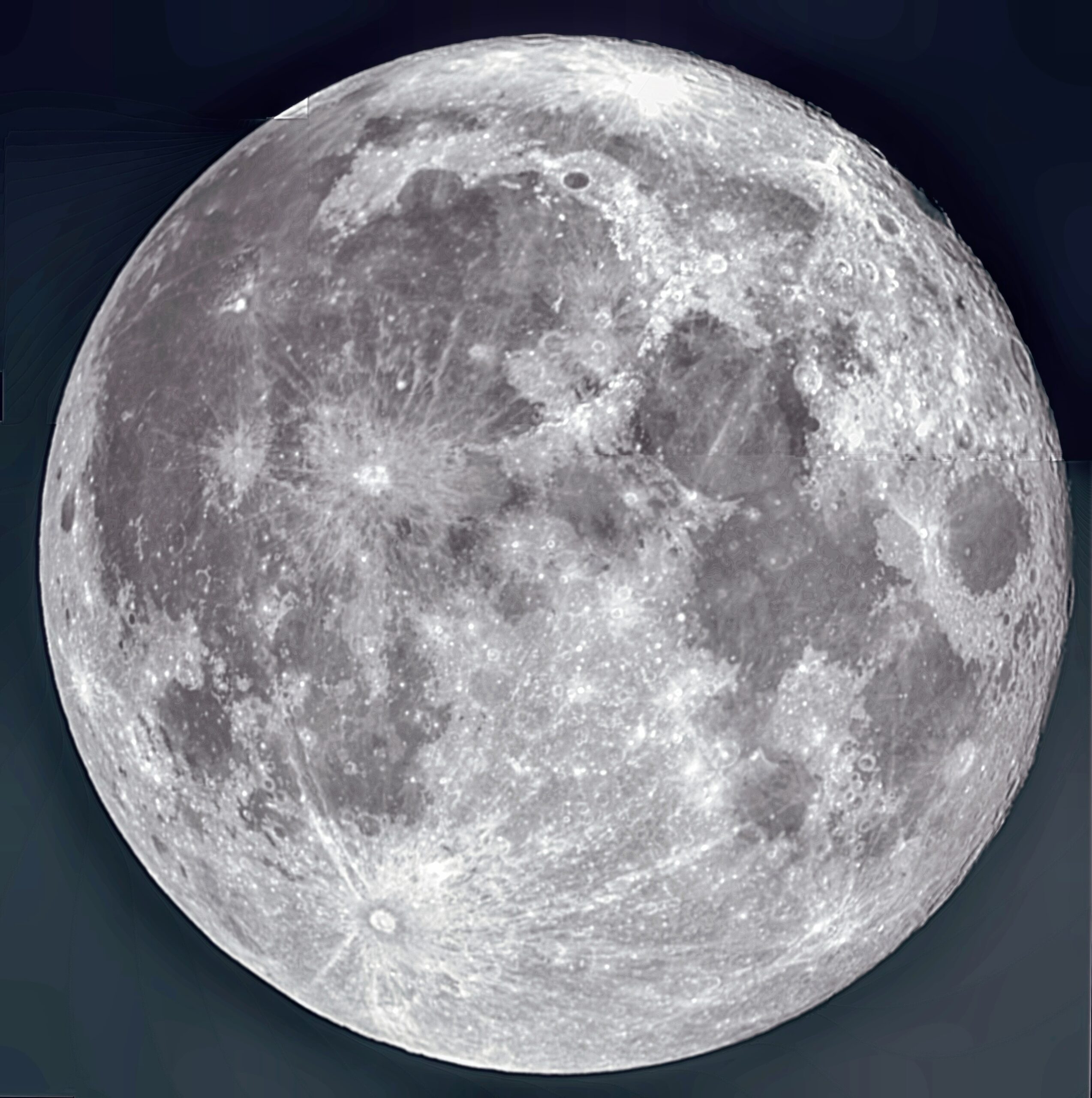
The Moon
The Moon is the most familiar world in the sky and, on close inspection, still the most astonishing. Older than every mountain on Earth, it carries on its surface an unedited record of four and a half billion years of impacts — a landscape preserved with a fidelity no other body in the inner solar system can match. Every glance at the full disk is a glance at the same face our deepest ancestors looked up at, and at a world whose stillness is more eloquent than any amount of geological noise.
The Moon is Earth’s only natural satellite, with a diameter of 3,474 kilometres, a mean distance of about 384,400 kilometres, and an apparent angular diameter close to half a degree. Its synodic period — the cycle of phases as seen from Earth — is 29.53 days, and it is tidally locked, so the same hemisphere always faces us. The dark maria are basaltic plains formed by volcanic flooding between roughly 3.0 and 3.8 billion years ago, while the bright highlands are older anorthositic crust dating from the magma-ocean phase around 4.4 billion years ago. Bright ray systems from craters such as Tycho and Copernicus mark comparatively recent impacts and dominate the disc at full phase. The Moon is gradually receding from Earth at about 3.8 centimetres per year, measured directly with laser retroreflectors left by the Apollo missions. Surface gravity is roughly one-sixth of Earth’s, and the lack of atmosphere preserves footprints, ejecta, and crater rims across geological time.
The Moon was just past full, blinding out any deep-sky work, so I turned the Celestron 14 EdgeHD on it instead. The C14’s field of view is narrower than the lunar disc, which made this my first ever attempt at a mosaic — 407 frames through the ASI2600MM Pro with a luminance filter, informally clustered around five centres across the surface rather than a tidy grid. High cloud drifted across in varying densities, easing as the night wore on. The stitching held together better than it had any right to. I’m fond of it more for what it points to than what it is: mosaicking opens the door to extended deep-sky targets.
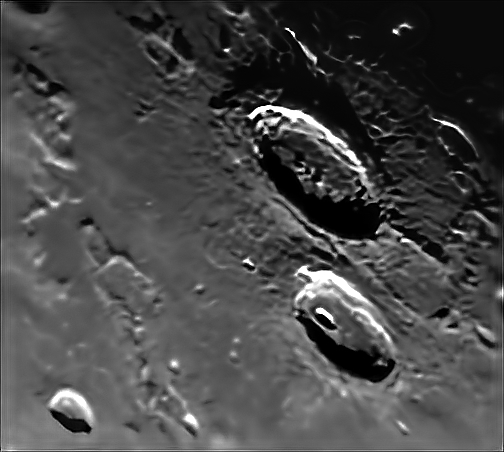
Atlas and Hercules Craters
There is a real wonder in resolving named places on another world. Atlas and Hercules sit side by side on the lunar north-east, two ancient impact scars carved into a frozen surface that has barely changed since the dinosaurs appeared on Earth. At the right moment in the lunar morning their rims catch the sunrise while their floors fall into deep shadow, and the disc stops being an abstraction and becomes a landscape — hills, depressions, slumps, and rilles, all of them older than almost anything alive.
Atlas and Hercules are large impact craters on the Moon’s northeastern near side, perched on the edge of Mare Frigoris. Atlas is about 87 kilometres in diameter with a complex floor showing rilles, dark pyroclastic patches, and central peaks; it is of Upper Imbrian age, around 3.2 to 3.8 billion years old. Hercules, its slightly smaller neighbour at about 69 kilometres across, shows a smoother lava-flooded floor with a single prominent central peak and the small interior crater Hercules G. The pair is best observed within a day or two of first or last quarter, when the terminator runs close by and rim shadows reach across the floors. High-resolution lucky-imaging or planetary-style stacking can resolve wall terraces, the dark mare patches inside Atlas (interpreted as volcanic deposits), and the fine ejecta texture on the surrounding terrain that vanishes under high-Sun illumination. The region is a favourite among lunar imagers because favourable libration and crisp seeing routinely reveal detail that is hidden in average conditions.
Personal commentary from George — coming soon. How the image was captured, what he likes about the result, and where he would like to take it next.
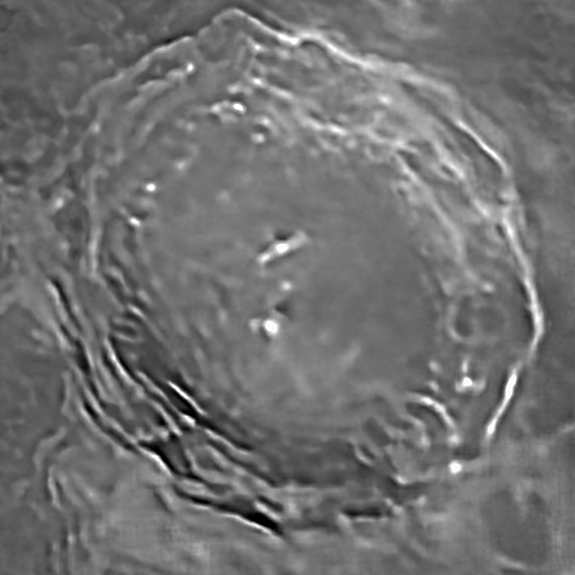
Copernicus Crater
Copernicus is one of the great spectacles of the solar system. A bowl ninety kilometres across, ringed by terraced walls that drop almost four kilometres to a floor crowned with central peaks, it is the kind of feature that would stop traffic if it sat on Earth. Carved out by an asteroid-scale impact only a few hundred million years ago — a blink, in lunar terms — it remains sharp, bright, and structurally pristine. Few places anywhere make the cratering history of the inner solar system feel so immediate.
Copernicus is a prominent young impact crater on the lunar near side, located in eastern Oceanus Procellarum near the southern rim of Mare Imbrium at roughly 9.6° N, 20.1° W. It is about 93 kilometres in diameter and 3.8 kilometres deep, with terraced inner walls and a cluster of central peaks rising approximately 1.2 kilometres above the floor. It is classified as Copernican — the youngest lunar stratigraphic system, named directly for this crater — and is dated at roughly 800 million years old, making it geologically young by lunar standards. Its bright ray system extends for more than 800 kilometres and dominates the surrounding mare near full Moon. The crater is best imaged within a few days of first quarter, when low solar elevation throws the wall terraces and central peaks into sharp relief. Apollo 12 returned samples of Copernican ejecta that were used to anchor the age estimate now adopted for the crater, making it a key time marker for the entire lunar surface.
This was one of the very first photographs I took with my Celestron 14 EdgeHD, and I wanted to see what the telescope could really do. At 3,910 mm focal length, Copernicus filled the field — the monarch of the Moon, instantly recognisable. I shot it with my ASI533MM Pro on a night of decent but not excellent seeing, before I really understood how to focus this rig. The terracing on the walls only emerged because I was just learning MultiScale Linear Transform in PixInsight. I’d love to revisit with thousands of short exposures, lucky-imaging style, on a steeper terminator — and chase real resolution on those central peaks. They enchant me.
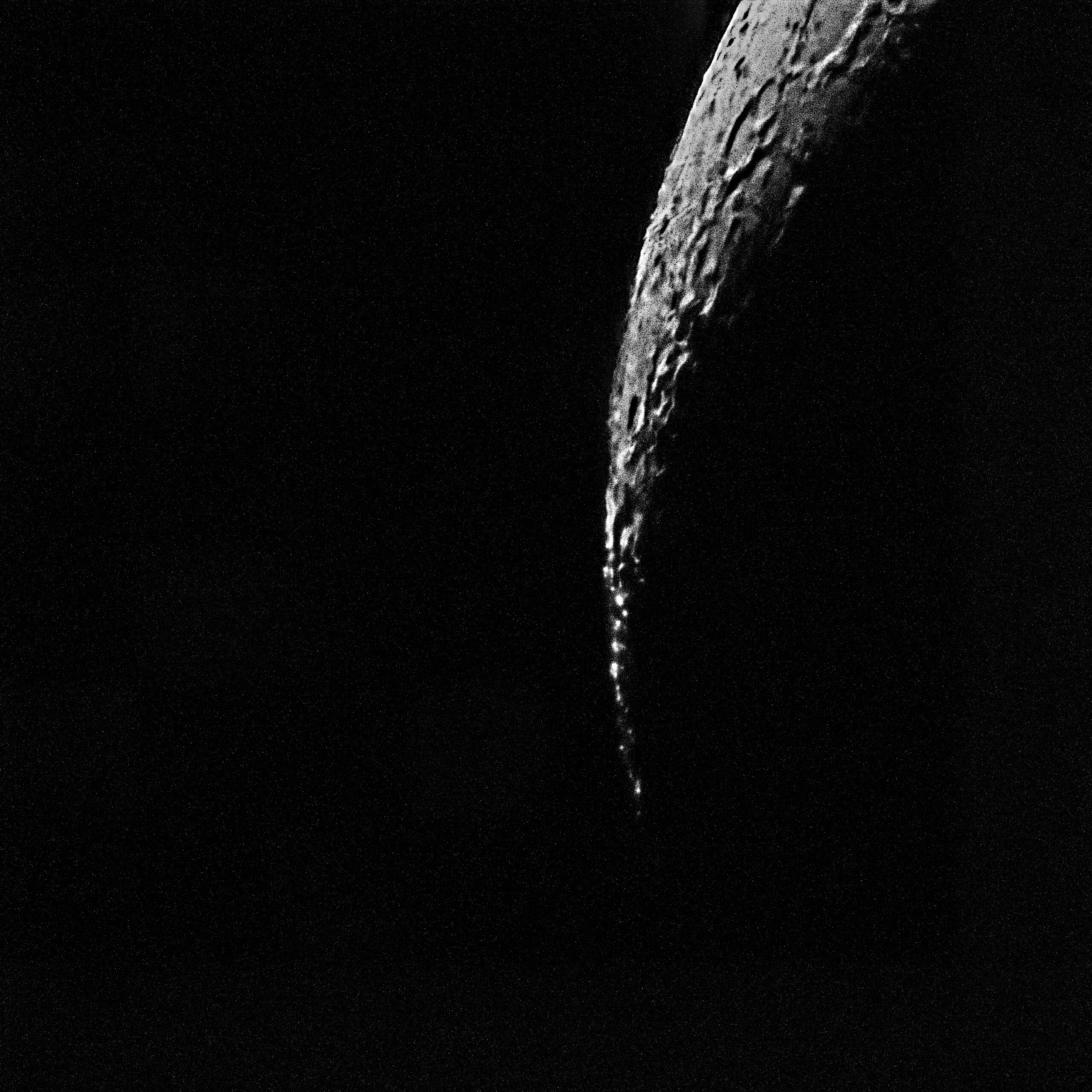
Lunar Crescent Horn
The horn of a young or old crescent is the Moon at its most delicate. For an hour or two near sunset or sunrise the thin tip of the illuminated limb burns against deep blue sky, a fragile arc of light only a few percent wide, before the geometry shifts and it is gone. Look closely along that edge and craters appear in vivid relief, lit from the side by a Sun barely above the lunar horizon. It is one of the most ephemeral and graceful views the Moon ever offers.
The terminator is the line dividing the illuminated and dark hemispheres of the Moon, and the cusps — or horns — of a crescent are the points at which the terminator meets the limb. Near new Moon the illuminated phase fraction may be only a few percent. Along the terminator the Sun stands extremely low in the local lunar sky, so even features only a few hundred metres high cast shadows kilometres long. This is why the terminator zone is the preferred region for high-resolution lunar imaging: crater rims, central peaks, ridges, and isolated mountains appear with a contrast unrecoverable under the overhead illumination near full Moon. Earthshine — sunlight reflected from Earth back onto the lunar night side — can faintly illuminate the unlit hemisphere on slender crescents, often visible in long exposures as the so-called ‘old Moon in the new Moon’s arms’. Crescent phases close to the Sun require careful timing in the brief twilight window and are easiest near the equinoxes, when the ecliptic stands steeply to the horizon.
Personal commentary from George — coming soon. How the image was captured, what he likes about the result, and where he would like to take it next.
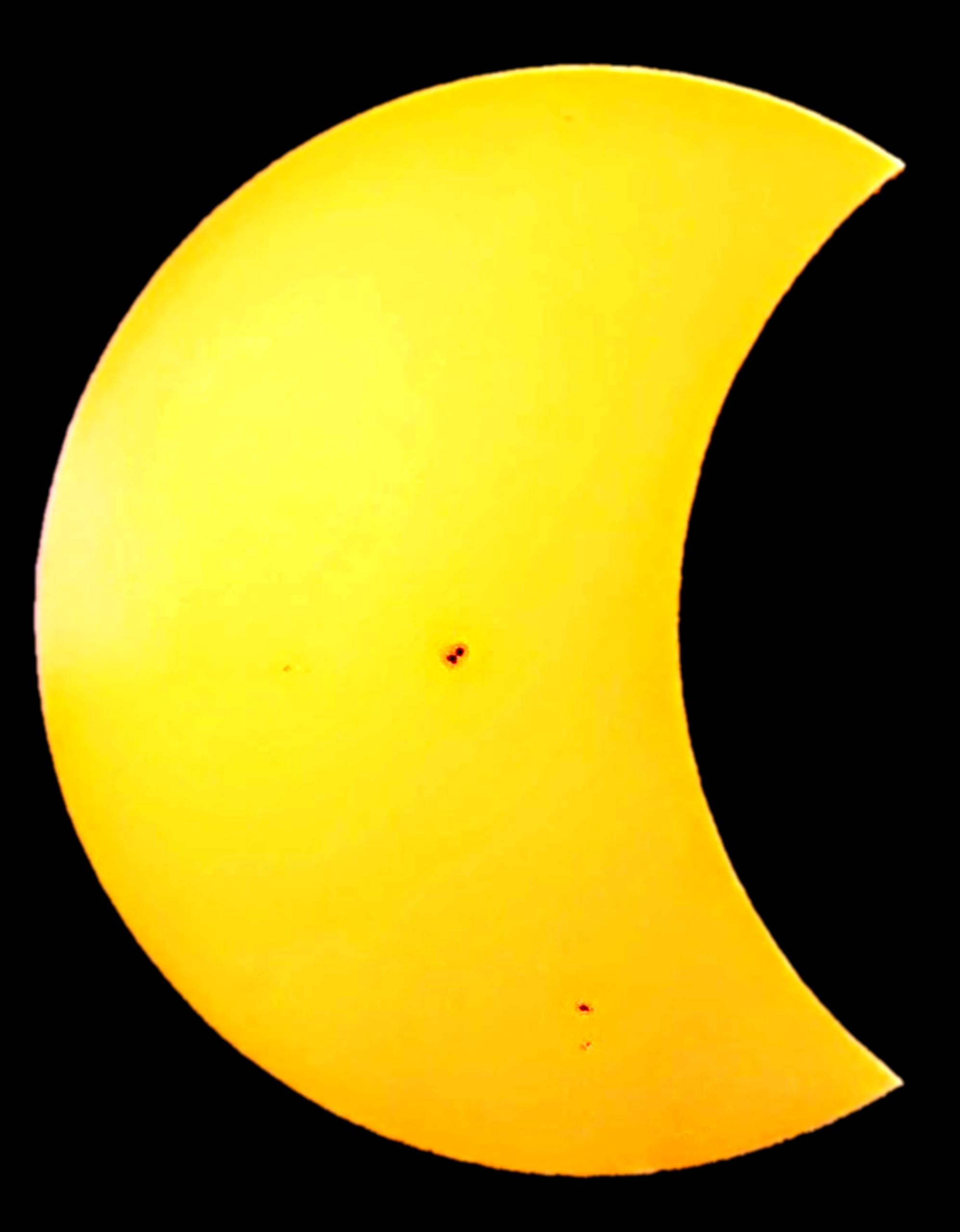
Partial Solar Eclipse, 8 April 2024
A solar eclipse is one of the few astronomical events the entire world watches at the same time. Even a partial phase carries a strange charge: the light cools, shadows sharpen into crescents, birds quieten, and the familiar Sun has a perfectly geometric bite taken out of it. The 8 April 2024 eclipse swept totality from Mexico through the heart of North America and on to the Canadian Maritimes, and pulled tens of millions of people outdoors. Its sheer rarity — the precise alignment of three bodies in a particular geometry — makes every recorded frame of it singular.
The 8 April 2024 total solar eclipse traced a path of totality from Mazatlán on the Pacific coast of Mexico, across the central United States from Texas to Maine, and into the Canadian Maritimes. The path was roughly 185 kilometres wide and totality lasted up to 4 minutes 28 seconds near the centre line in Mexico — one of the longest North American totalities of the twenty-first century. Observers outside the path saw a partial eclipse of varying magnitude. The Sun has a true diameter of about 1.39 million kilometres and lies an average of 149.6 million kilometres from Earth (one astronomical unit). The Moon’s diameter is 3,474 kilometres and its distance varies between roughly 357,000 and 406,000 kilometres. The coincidence that the Moon and Sun subtend almost identical angular diameters — about half a degree — is what makes total solar eclipses possible from Earth at all, and is itself a temporary state: the Moon is receding from Earth, and in about 600 million years total eclipses will no longer occur. Direct solar imaging requires a certified filter at the front of the optical train.
I would never miss an eclipse if I had the chance to photograph one, and I wanted a record of this one from where I live. From the village green in Hidden Springs, Idaho, around 35% of the Sun was covered at maximum — far from the path of totality cutting across Texas and Maine — yet the disk was crystal clear, with massive sunspots and the sharp irregular limb of the Moon revealing its mountains. I shot it through my Oberwerk 127 binocular telescope on its tracking alt-azimuth mount, with solar filters on the front, holding my phone to the eyepiece. Passers-by came over to look — warm, friendly, unhurried.